Where the Handoff Waits
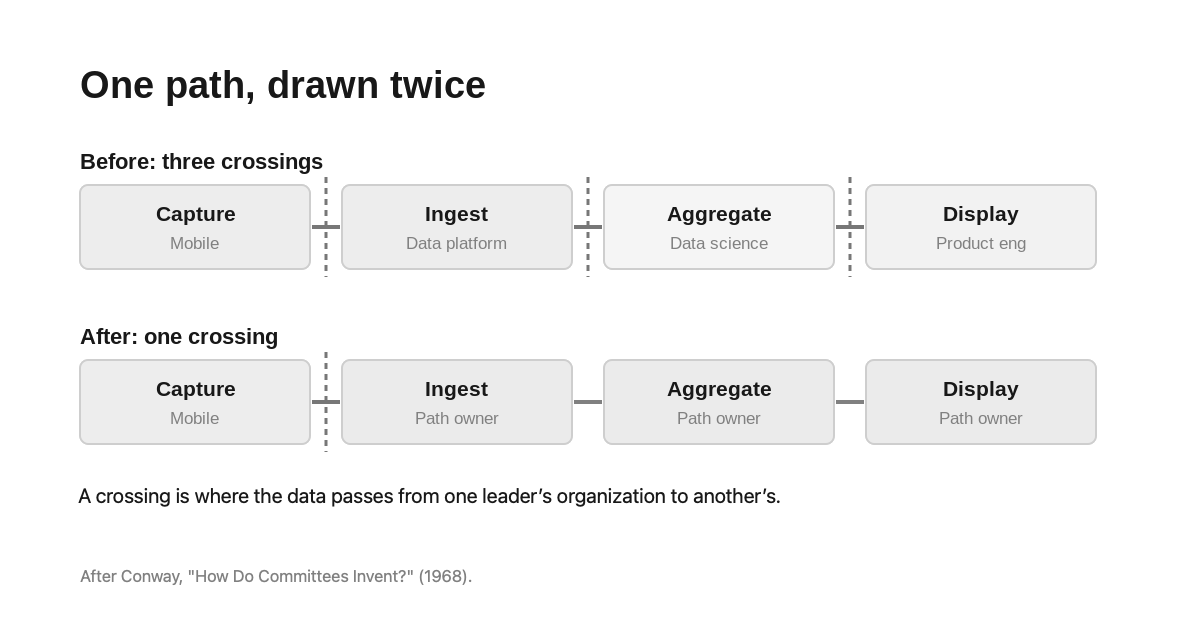
Before I move a team, I want to know which decision the move will make easier.
A clean org chart makes a quarterly plan look tidy on slides. For the engineers moving, a reorg means a new manager, unfamiliar peers and disrupted context. Leaders owe people a concrete explanation of what gets faster on Monday morning.
Trace a customer dashboard change that needs one new event from the mobile app. Mobile emits the payload, ingestion validates the schema, streaming aggregation rolls it into hourly tables, and the web team renders the chart. Four roadmaps stand between a small product question and a shipped answer.
Combining all four groups into one vertical squad looks tempting until you ask why the ticket is actually waiting. Sometimes the event's business definition isn't settled. Sometimes ingestion accepted more platform commitments than it staffed. Sometimes another product launch genuinely outranks the dashboard change.
Putting everyone under one director gives that director a single room to make the priority call. It does not create extra engineering hours out of thin air, and past a certain headcount even that room turns into an audience unless you break the work into smaller scrums with clear decision rights.
That is the operational core of Melvin Conway's 1968 observation: communication paths shape the system interfaces an organization can sustain. Thoughtworks's Inverse Conway Maneuver turns that insight around by structuring teams to match the architecture you want to build.
Running multi-team orgs at Amazon Prime, AWS IoT and Foursquare taught me that reporting lines only help when planning cadence, on-call ownership and incentives move with them. Sharing a VP three layers up doesn't help an IC engineer whose schema PR is stuck behind another group's quarterly lock.
End-to-end product teams move fast when the platform interfaces underneath them are self-serve. Without self-serve contracts, an 'empowered' feature owner spends half the sprint lobbying sibling teams for queue priority.
System duplication often reveals those organizational bottlenecks before anyone complains in a retro. When two product teams maintain shadow copies of the same spatial dataset, look past the messy architecture diagram first. Dedicated replicas sometimes reflect legitimate latency or blast-radius isolation, and just as often prove that upstream schema changes take six weeks to negotiate.
Reorganizing makes durable sense when the same engineers repeatedly have to resolve tightly coupled product and data tradeoffs week after week. Give them shared context and commit authority so routine iteration stops feeling like a cross-company treaty.
State the cost of the move openly too. Embedding specialists inside one vertical team thins out the shared platform for every other product line and separates niche practitioners from peers who sharpen their craft. Every honest org proposal names which handoff disappears, who makes the call now, and which neighboring roadmap pays the tax.
Continue in Engineering Org & Leadership
The Next Engineer Has to Learn Somewhere
Last week I wrote why a token-consumption chart is an expense report rather than proof of engineering productivity. Funding open-ended exploration makes…
The File Was Third
The right file sat third on the candidate list. Then my bug-investigation agent ran one more search pass and pushed it down to fifteenth. I hit that…