How Small Can a LoRA Adapter Be?

What drew me to the LoRA paper is why low-rank adaptation works: useful task changes often need far fewer degrees of freedom than pretraining the base model took.
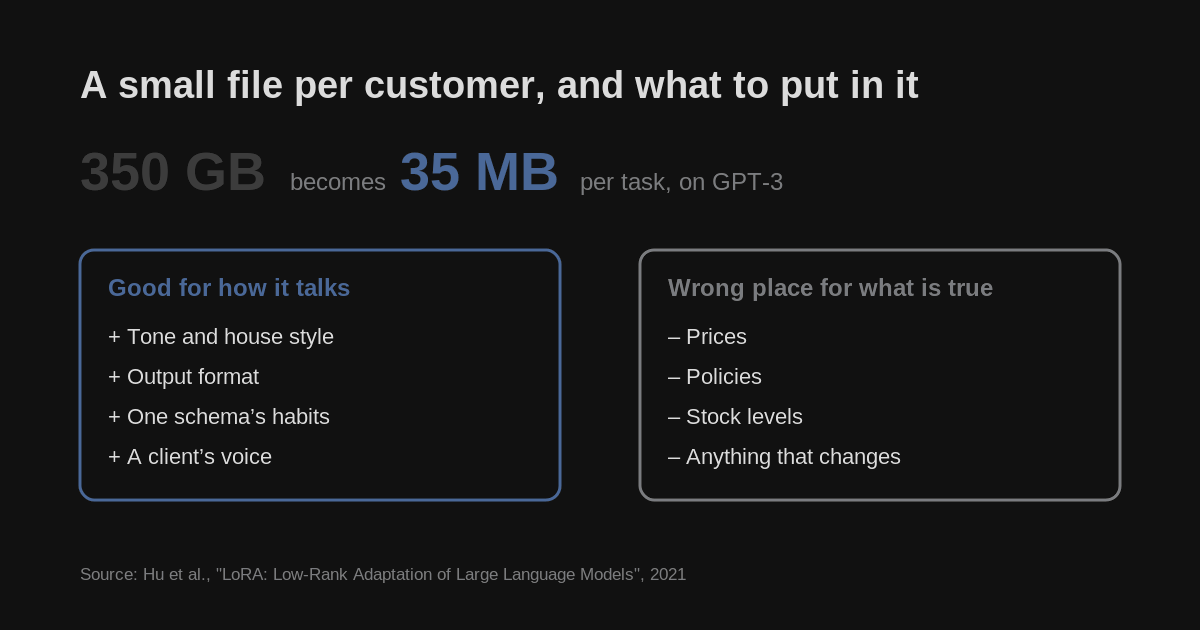
In Hu et al.'s 2021 LoRA paper, freezing pretrained transformer weights and parameterizing task updates as the product of two thin matrices cuts GPT-3 175B checkpoint size from roughly 350 GB to 35 MB while matching or beating full fine-tuning across benchmark tasks.
Take a four-by-four grid of weight updates to see what that compression gives up:
| Row | Four entries |
|---|---|
| 1 | 2, 4, 6, 8 |
| 2 | 3, 6, 9, 12 |
| 3 | 5, 10, 15, 20 |
| 4 | 7, 14, 21, 28 |
Two four-number vectors, 2, 3, 5, 7 and 1, 2, 3, 4, reconstruct all sixteen cells via outer multiplication. Storing eight numbers instead of sixteen enforces a structural constraint: every row scales the same underlying direction. Changing one cell independently without disturbing its neighbors becomes impossible at rank one.
LoRA applies that rank constraint strictly to the learned delta rather than the frozen pretrained matrix. Pretrained weights retain full rank, while the task adapter learns a low-dimensional shift on top of them. Raising the adapter rank adds independent directions when a harder domain shift demands more capacity, trading parameter count directly against expressiveness.
That distinction separates the cost of general language competence from the cost of steering behavior toward a narrow workflow. Pretraining pays for broad representations once, and task adaptation adjusts only the subspace that moves downstream accuracy.
Production deployment splits along a second axis once training finishes. Merging the low-rank product back into the base weights adds zero inference latency when traffic goes to a single specialized model. Keeping adapters unmerged lets one shared base model serve dozens of tenant-specific adapters in GPU memory, shifting the engineering work into batched multi-adapter kernels, adapter caching, and per-request routing overhead.
Evaluating a proposed adapter setup comes down to two concrete checks rather than admiring a 35 MB artifact size. First, verify on held-out failure cases whether a low-rank delta actually captures the target task or stalls below full fine-tuning. Second, measure throughput and tail latency under the real mix of concurrent adapters. And treat folklore that adapters only alter output style with skepticism: weight updates follow training loss, without any built-in barrier between formatting habits and domain facts.
Continue in Paper Reviews
A Tighter Bound, More Mistakes
In Lamb, Torr, and Rudner's November 2026 paper on LLM judges, what caught my attention is that the tightest statistical bound comes from an adapter making…
SGLang RadixAttention: Put the Prompt Timestamp Last
Giving a language model the current timestamp is reasonable. Putting that changing timestamp on line one of a long system prompt is expensive. That is the…