ReAct's Awkward Result
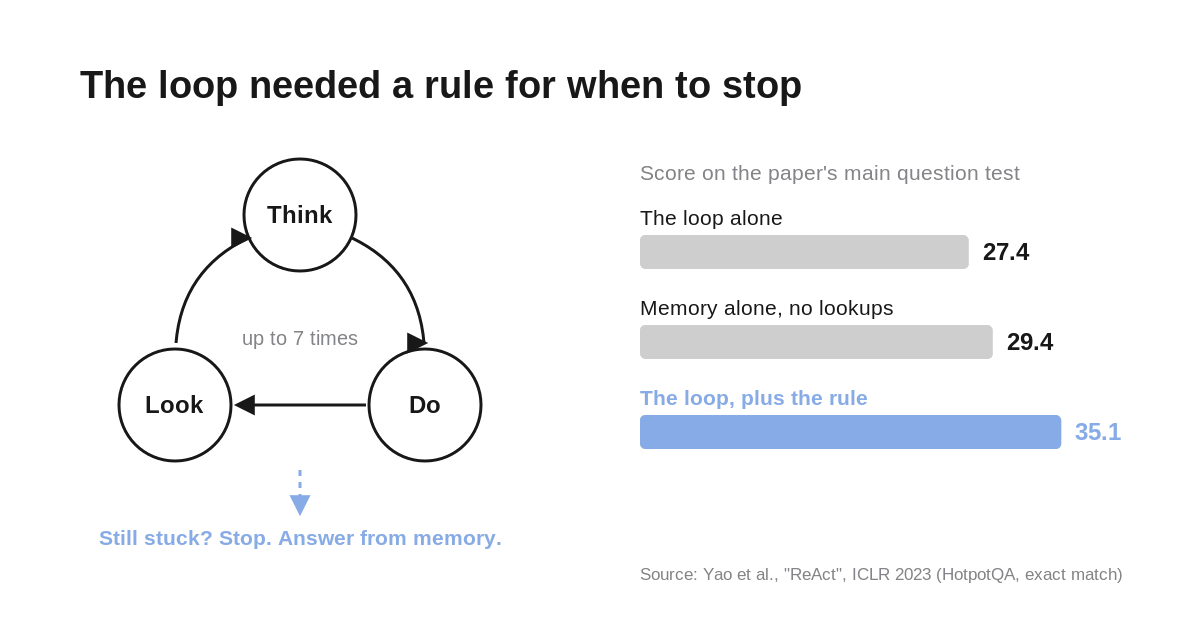
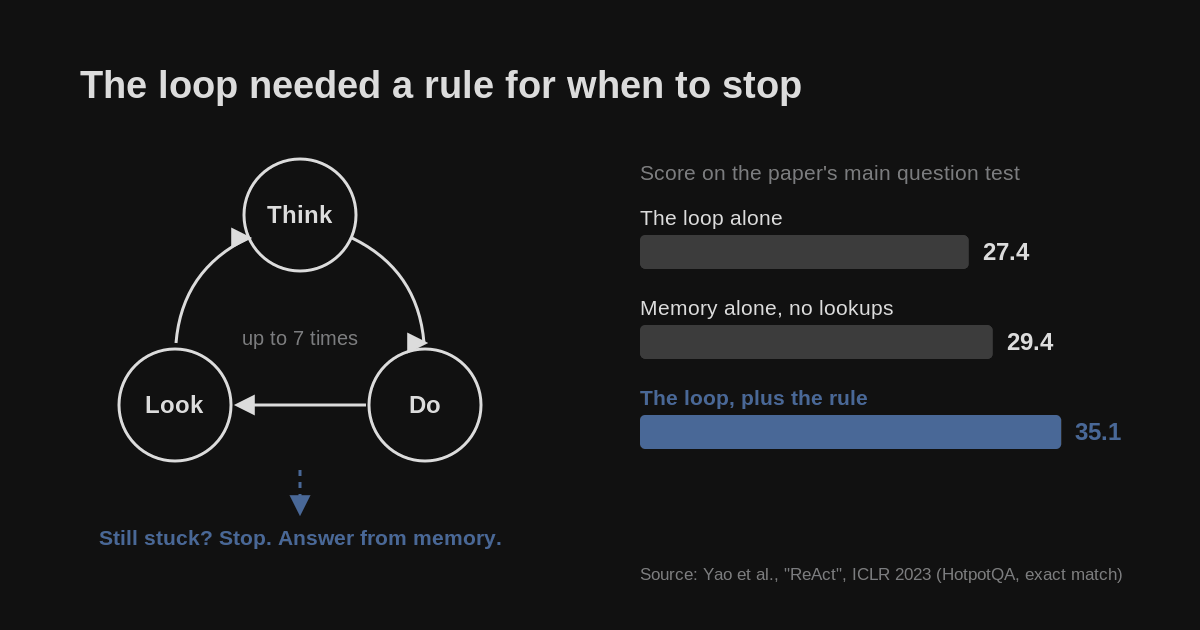
In Yao et al.'s ReAct benchmark on HotpotQA, PaLM-540B scored 27.4% exact match with retrieval against 29.4% for closed-book chain-of-thought. Giving the model live Wikipedia lookup lowered standalone accuracy on that multi-hop test before hybrid fallbacks were added.
That Table 1 number is worth pausing on whenever tool access gets equated with reliability.
ReAct interleaves generated reasoning traces, search actions, and returned observations in a single loop. Inspecting failed trajectories showed symmetrical failure modes: closed-book chain-of-thought fabricated facts, whereas ReAct got trapped repeating unproductive queries or let weak search snippets derail subsequent reasoning. On FEVER fact verification, ReAct pulled ahead at 60.9% versus 56.3% for chain-of-thought, and combining ReAct with self-consistent chain-of-thought beat either method alone.
Tool-augmented question answering splits into two distinct jobs: fetching the right evidence, and updating the final answer faithfully when that evidence arrives. Logging a tool call proves neither happened.
When an internal policy bot searches company docs and returns a confident wrong answer, two separate bugs can explain the miss. Either search pulled a policy written for another region, or search returned the exact right clause and the model ignored an explicit exception inside it. Faster indexing fixes the first failure and does nothing for the second.
Logging retrieved passages right beside the final answer separates retrieval misses from reading comprehension failures in evaluation. What I value most in ReAct is how the interleaved thought trace makes debugging concrete, provided engineers remember that generated rationale text is another model output rather than a guaranteed window into internal weights.
Continue in Paper Reviews
A Tighter Bound, More Mistakes
In Lamb, Torr, and Rudner's November 2026 paper on LLM judges, what caught my attention is that the tightest statistical bound comes from an adapter making…
SGLang RadixAttention: Put the Prompt Timestamp Last
Giving a language model the current timestamp is reasonable. Putting that changing timestamp on line one of a long system prompt is expensive. That is the…