466 Job Interruptions Training Llama 3
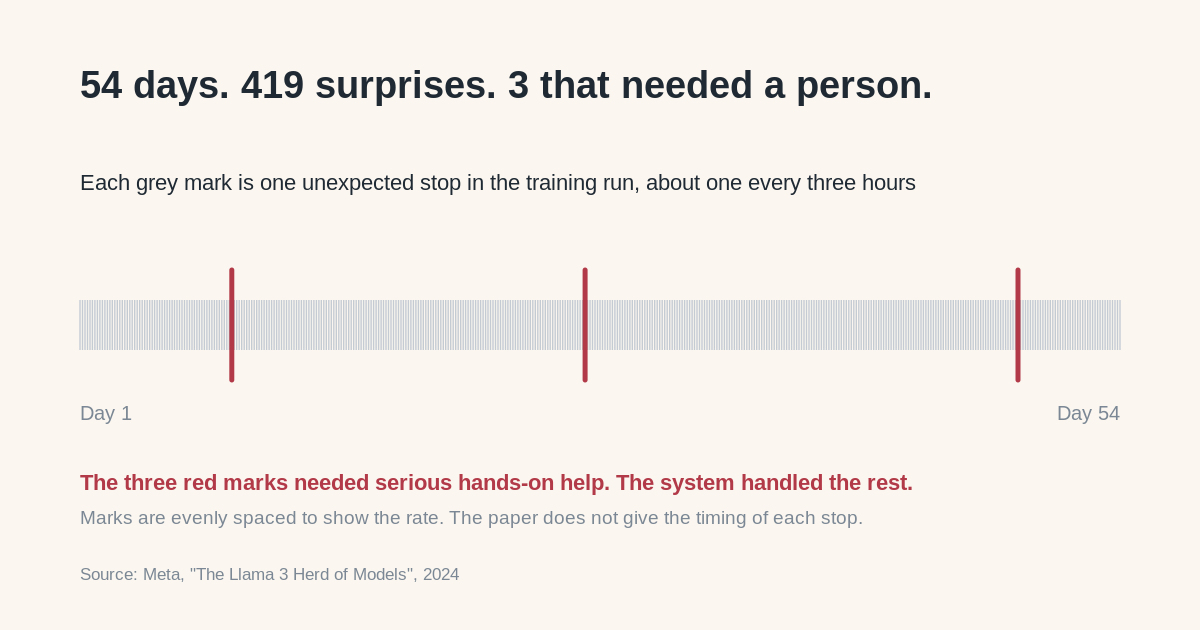
During a 54-day Llama 3 pretraining window on up to 16,000 GPUs, Meta logged 466 job interruptions and needed manual intervention on three.
Most of the systems engineering in frontier model training sits right inside the gap between 466 stops and three human rescues.
| Reported during the 54-day window | Count |
|---|---|
| Planned interruptions | 47 |
| Unexpected interruptions | 419 |
| Interruptions requiring significant manual intervention | 3 |
Synchronous data-parallel and pipeline-parallel training couples thousands of accelerators tightly enough that a single unhealthy H100, flaky optical transceiver, or silent host hang can halt progress across the entire job. Despite nearly nine interruptions per day, Meta sustained over 90% effective training time, measured as productive gradient computation divided by wall-clock elapsed time.
Read as an infrastructure report rather than a model benchmark card, Section 3.3 describes a high-speed automated recovery loop: fast health checks to isolate bad nodes, distributed storage throughput tuned so checkpoint writes and reloads take seconds rather than tens of minutes, and Flight Recorder collective-communication diagnostics to catch hung NCCL collectives without waiting on long timeouts.
Even "three manual interventions" leaves plenty of invisible human engineering underneath, from hardware replacement queues to silent data-corruption tooling. One 54-day slice doesn't tell you how many systems engineers built the automation before day one.
Look at what effective training ratio does directly to launch calendars on a workload needing 50 cluster-days of pure math:
| Productive share of wall-clock time | Calendar days to finish |
|---|---|
| 100% | 50 days |
| 90% | ~55.6 days |
| 80% | 62.5 days |
Dividing required compute by effective utilization turns cluster recovery latency straight into ship dates. Buying enough GPUs for 50 days of arithmetic never buys a 50-day schedule once checkpoint reloads, lost steps since the last save, straggler restarts, and maintenance windows claim their share.
Checkpointing interval becomes a quantitative control problem. Checkpoint too often and healthy training stalls behind storage writes. Checkpoint too rarely and every hardware fault throws away hours of forward and backward passes across 16,000 GPUs. Optimal frequency moves with mean time between failures and storage write bandwidth.
Tracking effective compute utilization alongside human escalation rate tells me whether cluster capacity scales with capital spend or bottlenecks on on-call heroics. At 16,000 GPUs, automated recovery isn't operational polish around the training run. It is how the run finishes at all.
Continue in Paper Reviews
A Tighter Bound, More Mistakes
In Lamb, Torr, and Rudner's November 2026 paper on LLM judges, what caught my attention is that the tightest statistical bound comes from an adapter making…
SGLang RadixAttention: Put the Prompt Timestamp Last
Giving a language model the current timestamp is reasonable. Putting that changing timestamp on line one of a long system prompt is expensive. That is the…