The Experiment Isn't the Product
The January 2025 DeepSeek-R1 report gets most interesting to me at the exact point where its training pipeline stops being pure.
DeepSeek-R1-Zero applies reinforcement learning directly to a pretrained base model without an initial supervised fine-tuning stage, rewarding final accuracy and tag formatting. Longer reasoning chains, self-verification, and backtracking emerge on their own, accompanied by tangled formatting and mid-sentence switches between English and Chinese.
Skipping preliminary SFT is a clean scientific control, though "no preliminary SFT" is narrower than learning from scratch. Pretraining already exposed the base weights to vast quantities of human mathematical text.
To ship DeepSeek-R1, the authors abandoned purity for a four-stage recipe: thousands of readable cold-start traces, reasoning RL, rejection-sampled supervised data across broader tasks, and a second RL pass for helpfulness and harmlessness. Their smaller dense releases take a third route by distilling directly from R1's outputs.
Readability is a reward term
During R1's reasoning RL stage, the team added a language-consistency reward even though it caused a slight dip on benchmark accuracy. Trading raw benchmark points for legible traces is a product call baked straight into the loss function.
A diagnostic assistant that buries a valid root cause inside an unreadable multi-language monologue shifts verification cost onto the engineer on duty. Measuring answer accuracy alone misses the minutes a person spends auditing assumptions before acting.
Check the evaluation denominator
In Section 2.2, R1-Zero reaches 71.0% pass@1 on AIME 2024 (and 86.7% with 16-sample majority voting). That pass@1 figure averages correctness across 16 sampled responses per problem rather than scoring a single greedy decode on 30 questions.
Evaluation denominators stop looking academic the moment two internal model proposals claim identical accuracy. One team is quoting single-pass latency and cost, while the other is paying 16x generation tokens plus a verifier or majority vote. Any architecture comparison has to pin sample count, token length, and tail latency beside the headline score.
Teacher distillation and checker traps
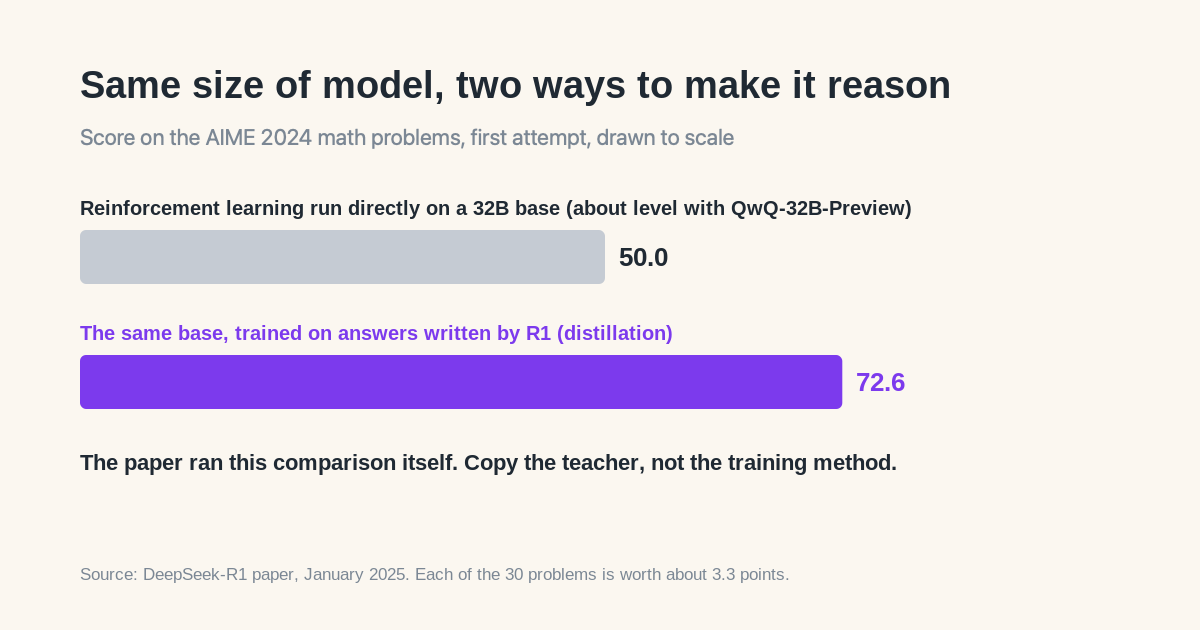
On the 32B Qwen base, distilling from R1 hit 72.6% pass@1 on AIME 2024 versus 47.0% for direct RL on the same 32B model. Before funding custom RL infrastructure, most product teams will get further by improving retrieval, tightening tool schemas, or distilling from a frontier teacher.
Once a team distills or filters synthetic traces, quality hinges entirely on the verifier. Generated SQL exposes weak verifiers immediately: a query can parse cleanly and return rows in milliseconds while joining on the wrong foreign key or dropping a date boundary. Run known-bad queries with duplicate joins and off-by-one time windows against your reward checker before launching a single training job. Where have you caught an automated evaluator rewarding fluent output that failed domain semantics?
Continue in Paper Reviews
A Tighter Bound, More Mistakes
In Lamb, Torr, and Rudner's November 2026 paper on LLM judges, what caught my attention is that the tightest statistical bound comes from an adapter making…
SGLang RadixAttention: Put the Prompt Timestamp Last
Giving a language model the current timestamp is reasonable. Putting that changing timestamp on line one of a long system prompt is expensive. That is the…