The Date on the Letter
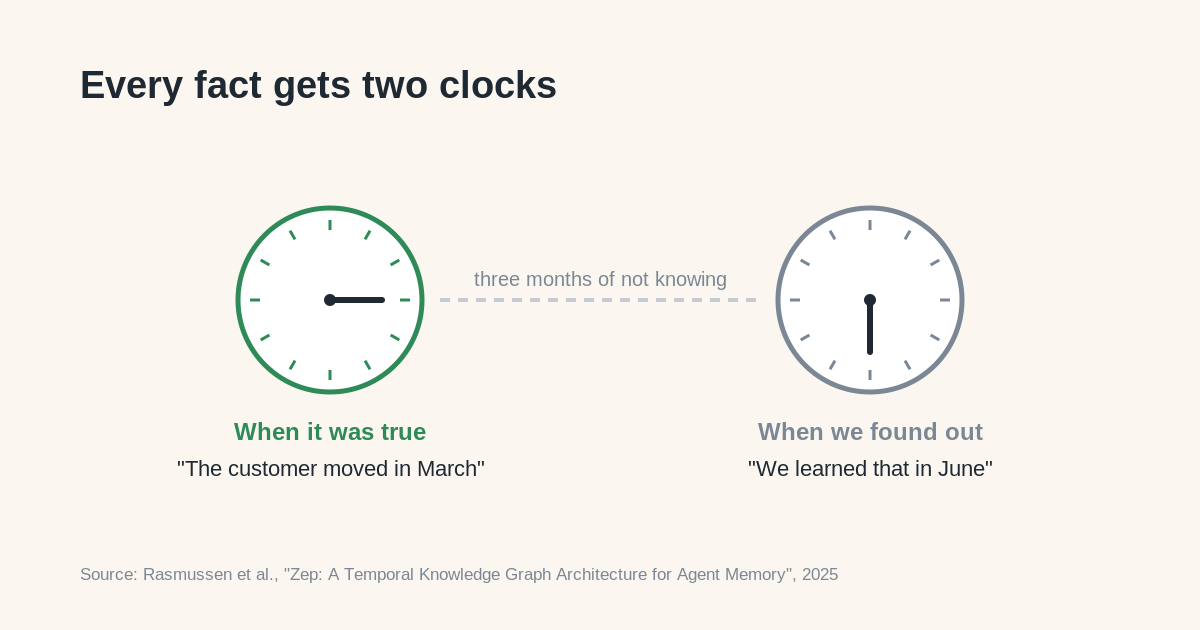
A late address change arriving in June for a March move carries two timestamps that an agent memory system cannot collapse into one. March 1 is when the customer moved to Denver in the real world. June 10 is when the system learned about it.
Back in January, Dana's profile listed an Austin street address, and an automated fulfillment workflow shipped a package there in May. Overwriting Austin with Denver on June 10 gives the assistant the right current shipping address while erasing the exact state needed to audit May's delivery.
Retaining superseded state lets an operator answer two distinct audit questions:
- Where was Dana living in May given everything known today? Denver.
- What shipping address did our system hold on the day May's order ran? Austin.
Database engineers call that split bitemporal modeling, separating valid time from transaction time. Martin Fowler's write-up on bitemporal history walks through retroactive payroll updates to show why ordinary business ledgers need both axes.
Zep's January 2025 Graphiti paper applies bitemporal tracking to agent memory (Section 2.2.3). Graphiti stores raw episodic messages alongside extracted entity-relationship edges that carry both world-validity intervals and system-ingestion timestamps, expiring stale edges on correction without deleting them.
You do not need a graph database to adopt that discipline. Append-only relational tables or versioned state documents preserve prior beliefs just as cleanly, provided updates expire old rows instead of mutating them in place.
Extraction accuracy is still separate from storage hygiene.
If Dana actually wrote, "I looked at apartments in Denver in March, then stayed in Austin," an LLM extractor can still write a false move edge. Wrapping an extraction error in four neat timestamps makes post-incident debugging faster without making the extracted fact true. Consequential state changes still need links back to the raw source message and explicit user confirmation.
Because Zep's authors build and sell the commercial product evaluated in the paper, treat their benchmark wins as vendor-reported numbers and test simpler append-only baselines against your own workload first. The bitemporal schema insight stands up regardless of storage engine.
Even a bitemporal memory store only covers one leg of an incident audit. Reconstructing why May's parcel went to Austin requires three linked records: the raw customer message, the memory snapshot retrieved during that run, and the outbound shipping payload. How are you versioning mutable user facts so an agent update today does not overwrite last month's audit trail?
Continue in Paper Reviews
A Tighter Bound, More Mistakes
In Lamb, Torr, and Rudner's November 2026 paper on LLM judges, what caught my attention is that the tightest statistical bound comes from an adapter making…
SGLang RadixAttention: Put the Prompt Timestamp Last
Giving a language model the current timestamp is reasonable. Putting that changing timestamp on line one of a long system prompt is expensive. That is the…