Decision Record: How a Sub-Agent Asks for More
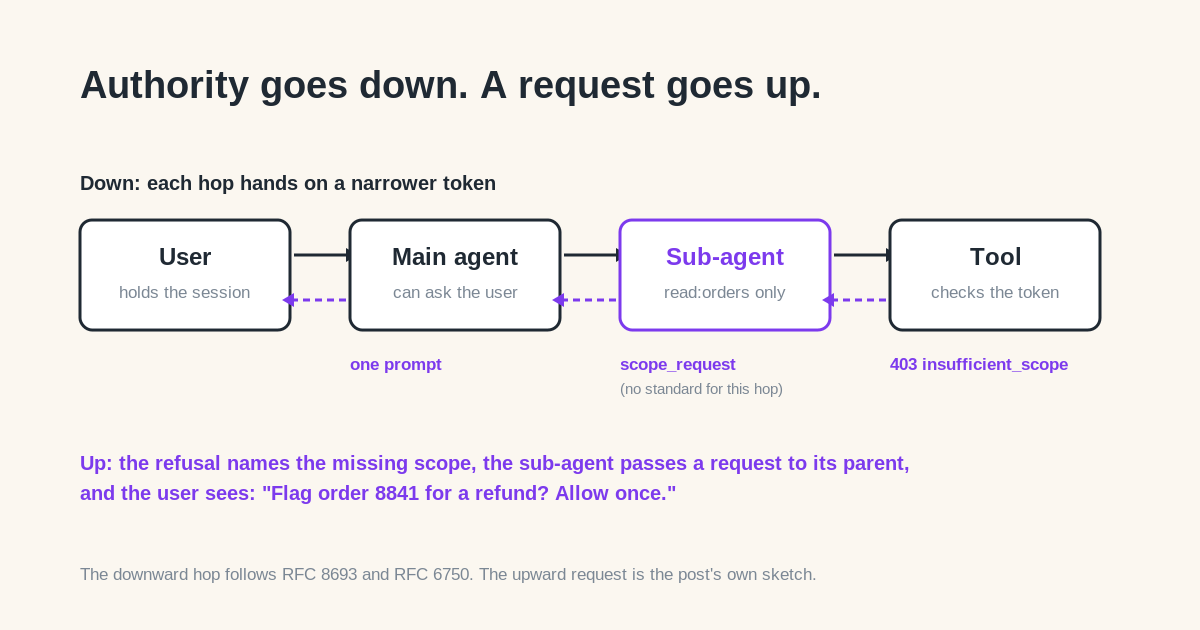
A delegated agent starts with permission to inspect an order, then discovers that finishing the job requires flipping a refund flag. Asking for authority and possessing it are separate states, and a fluent explanation from a model supplies neither a grant nor proof that the action is safe.
Read-only start, write-scope discovery
When a sub-agent hits a permission boundary, two bad habits show up fast: broad initial scopes granted out of convenience, or retry loops where the model rephrases a denied tool call hoping it slips past. Making missing authority an explicit, typed escalation avoids both failure modes.
Token attenuation and exchange primitives
Macaroons demonstrate how a credential holder appends caveats that downstream holders cannot strip, including third-party caveats discharged by an external service. They solve narrowing on the way down, not step-up requests on the way back up.
OAuth 2.0 Token Exchange (RFC 8693) lets an authorization server mint a target-scoped token under its own policy and record delegation history via nested act claims. Those nested actor entries remain audit metadata rather than extra permissions, and exchange alone does not guarantee narrower rights.
The November 2025 MCP authorization specification mandates audience-specific token validation, forbids forwarding inbound tokens downstream, and pairs RFC 6750 insufficient-scope challenges with step-up consent. Even with those primitives in place, the application still owns who may request broader scope and how that request reaches a human or policy engine.
Controller-mediated escalation
Keep bearer credentials out of model-generated messages and route unmet scope needs through a trusted controller:
{
  "type": "authority_request",
  "action": "set_refund_flag",
  "resource": "order/8841",
  "reason": "Possible duplicate charge",
  "evidence_refs": ["charge-check/72"]
}
Every string in that payload is untrusted input, not a capability token.
The controller checks the caller's session and task ceiling first. When additional consent is required, it surfaces the exact action and target object to the user: "Set the refund-review flag on order 8841?" A denial terminates that branch, while an approval mints a credential bound to that single action and resource.
For one-shot mutations, short token TTLs do not prevent replay. The authorization server or target tool must consume a nonce or idempotency key so a dropped network response never turns recovery into a second refund action.
Replay, stale state, and split actions
Scope errors belong on an authorization path rather than a backoff timer. Before executing an approved escalation, the controller also has to re-verify order state against primary records so prompt injection inside retrieved text cannot fabricate urgency or act on a stale snapshot.
When I review delegated agent designs, three adversarial cases separate a sound escalation boundary from a rubber stamp: a legitimate missing grant, a forged request planted inside retrieved ticket text, and two individually narrow requests whose combined side effect exceeds the task ceiling. How are you bounding cumulative side effects when an agent splits work across sub-agents?
Continue in Paper Reviews
A Tighter Bound, More Mistakes
In Lamb, Torr, and Rudner's November 2026 paper on LLM judges, what caught my attention is that the tightest statistical bound comes from an adapter making…
SGLang RadixAttention: Put the Prompt Timestamp Last
Giving a language model the current timestamp is reasonable. Putting that changing timestamp on line one of a long system prompt is expensive. That is the…