MapReduce Was Allowed to Try Again
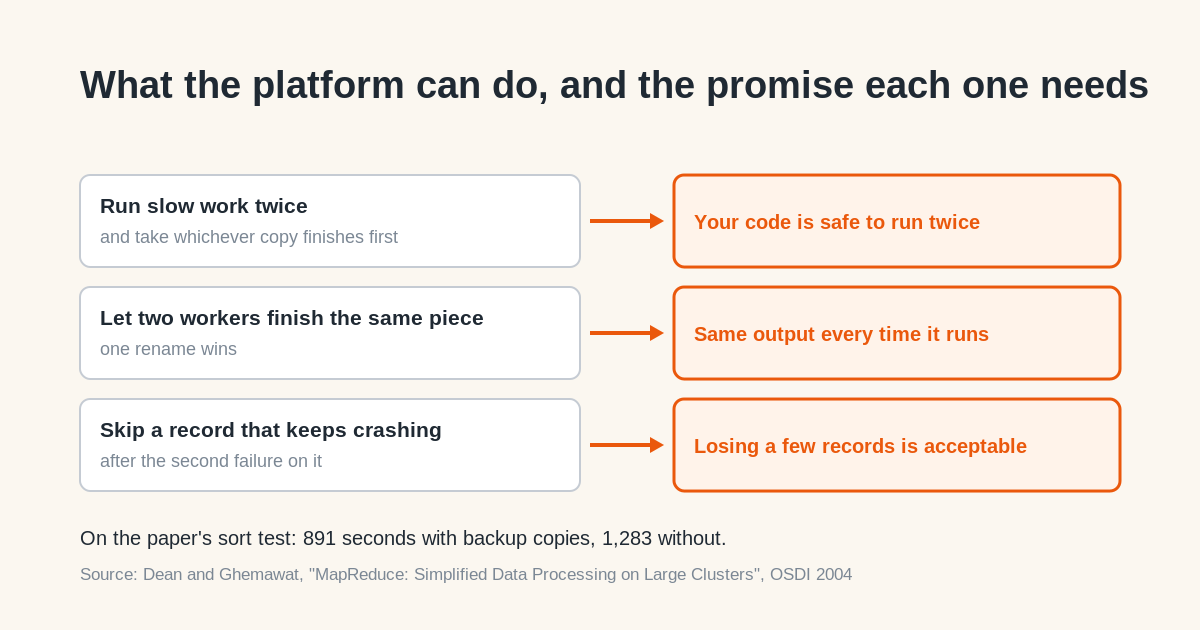
What stands out on rereading Google's 2004 MapReduce paper is how much control it strips away from the engineer writing a batch job.
When I run large-scale data processing on an internal platform, I want my team's energy spent on domain logic rather than cluster plumbing. Every knob exposing worker placement or partial retry state becomes another failure mode application engineers have to reason through before trusting their output. Giving up arbitrary control flow is a bargain worth taking when the runtime absorbs machine failures in return.
Jeffrey Dean and Sanjay Ghemawat's OSDI 2004 MapReduce paper draws that boundary with unusual discipline. Application code supplies Map and Reduce. Partitioning, shuffle transport, scheduling, and dead-worker recovery belong entirely to the framework.
Counting words across two short documents ("red blue" and "red") shows what that restriction unlocks. Map emits each token with a count of 1, the shuffle groups counts by key, and Reduce sums them.
Because the output never depends on which physical host scanned the first document, the master is free to re-execute failed or stranded tasks anywhere in the cluster.
Committing outputs safely still takes careful file choreography. Workers write to private temporary files first. Duplicate completions of an already finished map task get ignored by the coordinator, while each reduce task publishes its output through an atomic filesystem rename. Even if two workers race on the same reduce partition, downstream readers see one coherent output file.
When Map and Reduce are deterministic, distributed execution matches a clean sequential run. Even under nondeterministic user operators, atomic per-task commit preserves a clear weaker contract where each reduce partition reflects one valid execution attempt.
Backup tasks near the end of a job are my favorite payoff in the paper. When a handful of straggler workers drag out job completion, the scheduler launches duplicate executions of the remaining in-progress tasks and keeps whichever finishes first.
Instead of building fragile heuristics to distinguish a wedged disk from a dead host, the runtime exploits idempotent task boundaries to route around uncertainty. Designing work so recovery requires less diagnosis is one of the best reliability moves in distributed systems.
External side effects remain deliberately outside that safety net. Calling an external billing or email API inside Map escapes temporary file rename, which is why the authors leave idempotent external mutations to application owners. Bolting arbitrary side-effect hooks onto a batch engine looks helpful in a feature request, yet quietly undermines the exact restriction that let the platform retry freely. Which restriction in your internal platforms buys the most operational simplicity today?
Continue in Paper Reviews
A Tighter Bound, More Mistakes
In Lamb, Torr, and Rudner's November 2026 paper on LLM judges, what caught my attention is that the tightest statistical bound comes from an adapter making…
SGLang RadixAttention: Put the Prompt Timestamp Last
Giving a language model the current timestamp is reasonable. Putting that changing timestamp on line one of a long system prompt is expensive. That is the…