Dear Product Manager: About Those Per-Store Counts
Dear product manager,
I want to know what decision a customer will make from a daily count of twelve.
That question comes first when designing privacy-protected store analytics. Publishing a number on a dashboard is easy. Establishing that the number is usable at single-store daily granularity is much harder.
Look at what happens on the release path when we publish visit counts for a fixed list of stores over one day. Each device contributes at most once per store and to at most five stores overall, and the release protects adding or removing one device's full day of activity.
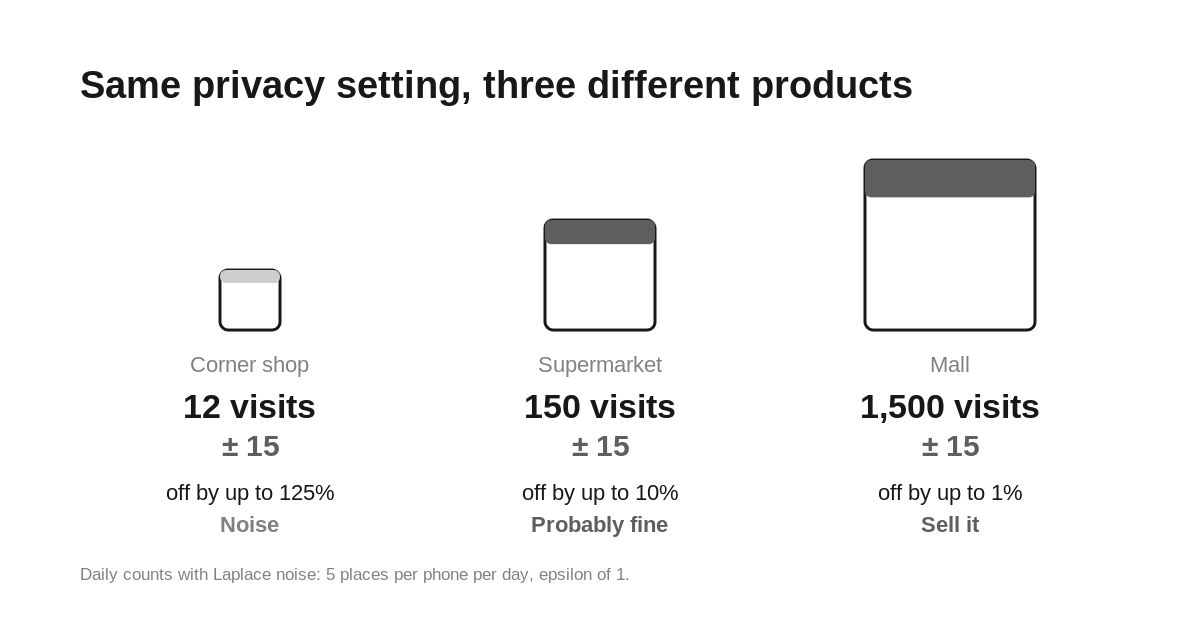
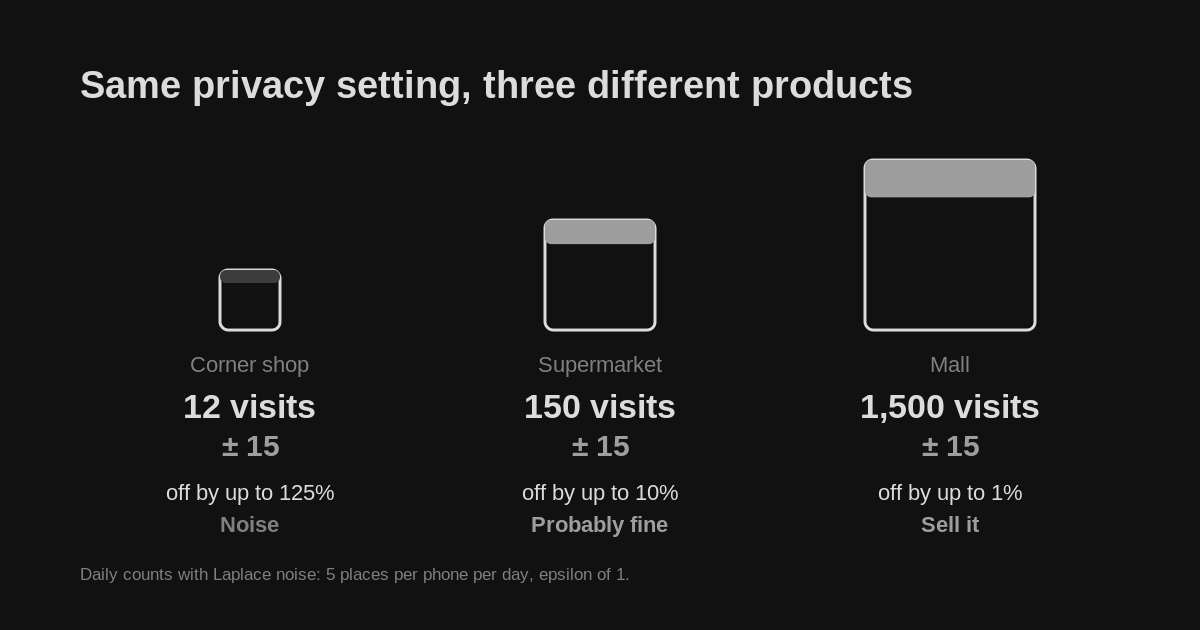
Because removing one device changes the count vector by at most five across all stores, its L1 sensitivity is 5. Using the Laplace mechanism with a privacy parameter of 1 gives a noise scale of 5 on every store count.
Roughly 95% of draws from that Laplace distribution fall between -15 and +15.
On a big-box store with 1,500 observed visits, plus or minus 15 barely moves the trend line. On a corner shop with 12 observed visits, the privacy noise alone swamps the signal.
Even before adding noise, the raw input is not 'people who walked in.' It is bounded contributions from opted-in devices that happened to be observed and attributed to that polygon. Panel coverage shifts after App Tracking Transparency, sensor uncertainty and attribution errors sit outside the differential-privacy noise band altogether.
That is why the customer's decision has to set the aggregation unit. Regional category demand and head-to-head daily comparisons between two quiet neighboring shops require completely different sample sizes.
Rolling up to weekly or monthly releases changes the math only when we design the contribution cap and privacy budget for that window up front. Summing seven already-published noisy daily numbers does not magically recover a clean weekly count, and releasing additional cuts of the same underlying panel spends additional privacy budget under composition.
Differential privacy also bounds a specific mathematical quantity: how much the output distribution shifts when one protected unit enters or leaves the dataset. Bounding single-device sensitivity in one release window is narrower than bounding person-level privacy across multiple devices over a quarter.
There is a genuinely valuable aggregate location product to build post-ATT. Its labels should state clearly what was measured, and its spatial and temporal resolution should stop where the signal runs out.
Would a count of twelve, carrying plus or minus fifteen in mechanism noise before panel bias, help a store owner staff Tuesday's shift? Let's answer that before putting the number in a table.
Ankit
Reference: Dwork and Roth, The Algorithmic Foundations of Differential Privacy (2014).
Continue in Engineering Org & Leadership
The Next Engineer Has to Learn Somewhere
Last week I wrote why a token-consumption chart is an expense report rather than proof of engineering productivity. Funding open-ended exploration makes…
The File Was Third
The right file sat third on the candidate list. Then my bug-investigation agent ran one more search pass and pushed it down to fifteenth. I hit that…