One Pin, Two Businesses
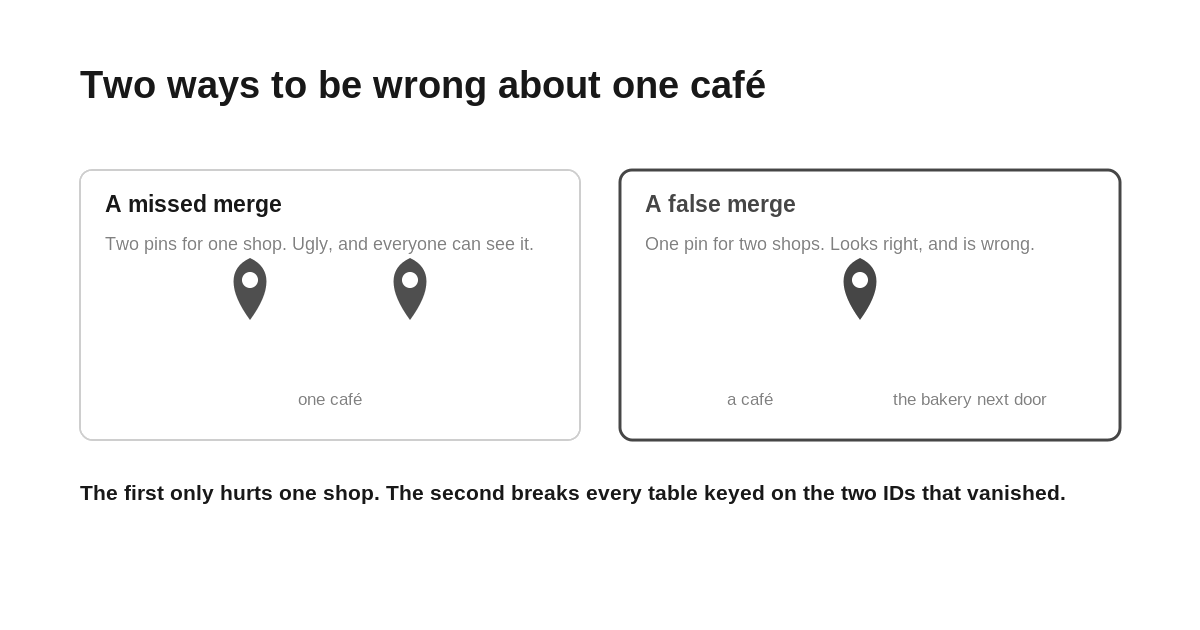
I have seen a map with one pin look cleaner in a demo than a map with two. If those pins represented different businesses, the cleanup made the data worse.
In a multi-story shopping center, two supplier feeds often spell the same cafe differently while an independent kiosk downstairs shares half its name. Point-of-interest entity resolution has to decide which source records describe the same physical venue and which belong to separate businesses.
A missed merge leaves visible duplicates in search. A false merge collapses distinct businesses into one canonical ID. Both hurt quality, yet false merges cause deeper downstream damage once enterprise customers join their own transactions, ad attribution or visit logs to your place IDs.
Once two businesses share an identity, their histories mix. Fixing a display name next month does not untangle the joins customers already wrote to disk.
Pair scores are not entity groups
At catalog scale, entity resolution splits into candidate generation and graph clustering.
All-pairs comparison grows quadratically with catalog size, so blocking rules narrow comparison to plausible neighbors using spatial cells, normalized name tokens, phone numbers or street addresses. Unioning complementary blocking rules protects recall, because a true match that never enters a candidate block will never be rescued by a smarter pairwise model.
After scoring candidate pairs, clustering turns pairwise links into canonical places. When a model scores A-B and B-C above the merge threshold while scoring A-C low, naive transitive closure still pulls all three records into a single entity.
Connected-components clustering makes that failure mode easy to see. Each accepted edge looked reasonable in isolation, yet a single bridge record linked two incompatible businesses.
Cluster-level diagnostics catch what pairwise precision misses. Internal edge density, conflicting phone numbers or chains, and sudden cluster growth all flag transitive bridges before publication. Size alone isn't disqualifying, since an airport terminal or major landmark legitimately attracts dozens of source records, so graph splitting has to weigh conflicting attributes alongside edge weights.
Inside a dense mall, separating the cafe from the kiosk relies on combined signals across category taxonomy, coordinates, suite numbers and source reliability. Hard-coding a strict category veto prevents one bad merge while breaking legitimate mixed-use venues like a bookstore cafe down the street.
Every merged ID needs a split path
Production place catalogs have to keep raw source records immutable and version the mapping from source inputs to canonical IDs. When record B merges into canonical place A, a Tombstone or redirect lets downstream pipelines follow the surviving ID cleanly.
Redirects only solve the easy direction. When new evidence proves that a previously merged place was actually two separate businesses, splitting A into A and C breaks one-to-one lineage. Customers maintaining foreign-key joins need explicit split tombstones, versioned crosswalk tables and effective timestamps so they know which historical joins require re-evaluation.
Confidence thresholds therefore belong to the product contract. Autocomplete search and enterprise data licensing tolerate different error profiles, even when both read from the same canonical graph.
Shipping a new resolution model requires checking both offline precision-recall and catalog churn against the prior release: merge counts, split counts, oversized components and churn on high-traffic customer IDs. Removing duplicate pins is only the surface job. Keeping place identities stable and reversible over time is what makes the catalog trustworthy.
Continue in Distributed Systems & Data
The Shortlist Decides Who Can Win
A location model can excel at ranking venues and still miss the cafe that opened last month if retrieval drops it before scoring runs. Once a venue is…
Geohash, S2 or H3?
'In the same parent cell' can describe a relationship between IDs or a relationship between shapes. With H3, those are two different promises. Every…