The Shortlist Decides Who Can Win
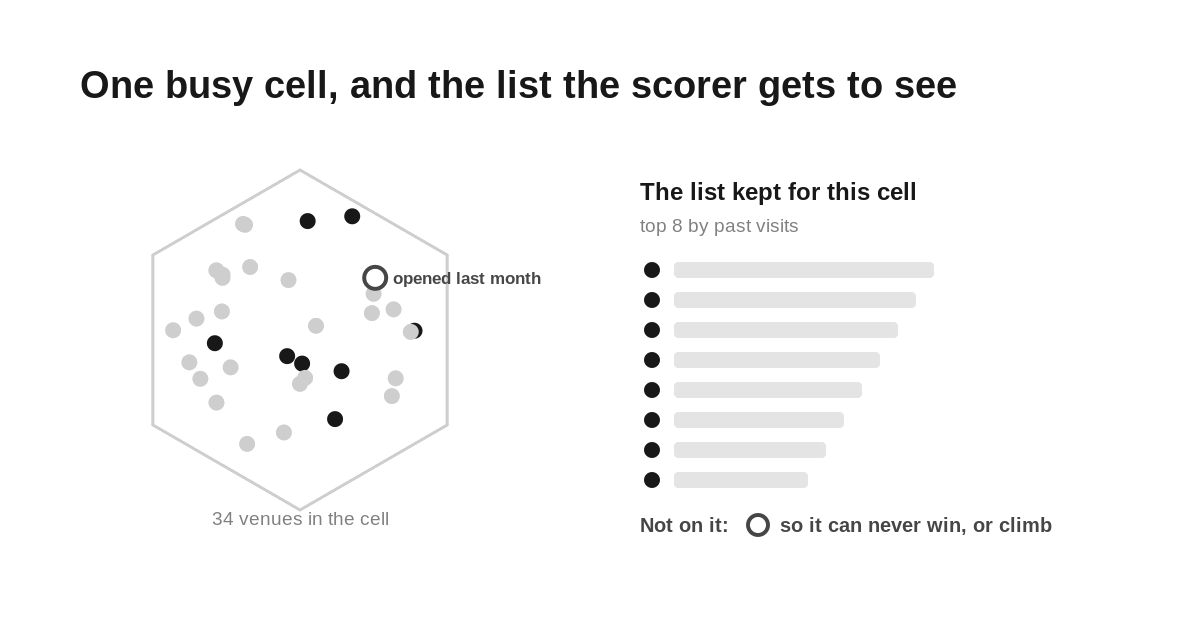
A location model can excel at ranking venues and still miss the cafe that opened last month if retrieval drops it before scoring runs.
Once a venue is excluded from the candidate shortlist, no amount of gradient-boosted feature engineering downstream can bring it back. In real-time spatial ML, candidate retrieval and feature serving quietly make product decisions before the ranker executes a single tree.
Every incoming mobile fix arrives with horizontal uncertainty. Serving has to map that noisy coordinate to candidate places, fetch fresh venue and context features, and score the set within tens of milliseconds. Key-value feature lookups by venue_id are fast and commoditized. Deciding which venue_id list to fetch in dense urban blocks is where latency and recall collide.
Precomputing candidate venue lists keyed by fine-grained spatial cells such as H3 keeps heavy geometric indexing off the live request path, at the price of explicit truncation and staleness tradeoffs.
Candidate caps and popularity feedback loops
Midtown Manhattan or central Tokyo cells can easily touch dozens of stacked retail, dining and transit venues inside a single GPS uncertainty circle. Bounding the candidate list per cell protects tail latency on the feature store, and the eviction rule determines which businesses remain discoverable.
In a dense block holding 80 active storefronts, capping the cell's stored candidate list at 30 forces a ranking choice up front. Pruning strictly by historical inferred visits creates a closed feedback loop: a newly opened shop has zero inferred visits, misses the top-30 cut, never reaches the scorer, and therefore never accumulates inferred visits.
Breaking that rich-get-richer loop takes deliberate exploration slots reserved for newly registered places, recent merchant edits or independent search-and-check-in signals, paired with adaptive candidate budgets in high-density commercial cells.
Track candidate recall separately from ranker NDCG or top-1 accuracy, sliced by storefront density, venue age and horizontal GPS uncertainty. Overall recall averages look comforting right up until you inspect venues under sixty days old.
Grid hops versus sensor error radii
Phones standing near a cell edge frequently belong to a storefront across the seam. H3's grid traversal functions expand outward by k-ring hops quickly, yet a fixed 1-ring lookup covers very different physical radii depending on cell resolution and indoor GPS degradation.
Search expansion has to scale with the reported horizontal accuracy radius rather than assuming one fixed k-ring fits both clear suburban sidewalks and urban canyons. When wide uncertainty pushes the candidate set past the online latency budget, return a calibrated low-confidence or unresolved state instead of silently truncating the ring and emitting a confident top-1 guess.
Decoupling cell-to-ID membership lists from per-venue feature records also keeps write amplification sane on top of upstream place entity resolution. Updating business hours or category tags touches one venue key, whereas opening, closing or relocating a storefront triggers cell-index rebuilds.
In my experience, offline training pipelines have to mirror that exact retrieval contract. Joining last autumn's movement traces against today's catalog leaks future closures and newly opened venues into historical labels. Point-in-time feature joins need to respect both historical feature timestamps and catalog ingestion lag so offline replay sees the exact shortlist live serving had available at that moment.
Continue in Distributed Systems & Data
Geohash, S2 or H3?
'In the same parent cell' can describe a relationship between IDs or a relationship between shapes. With H3, those are two different promises. Every…
Noon Arrives at Three
A phone records a store visit at noon inside a subway station, stays offline for three hours, and uploads the batch at three. Every mobile event carries two…