Two Berkeley Papers, One Unfinished Idea
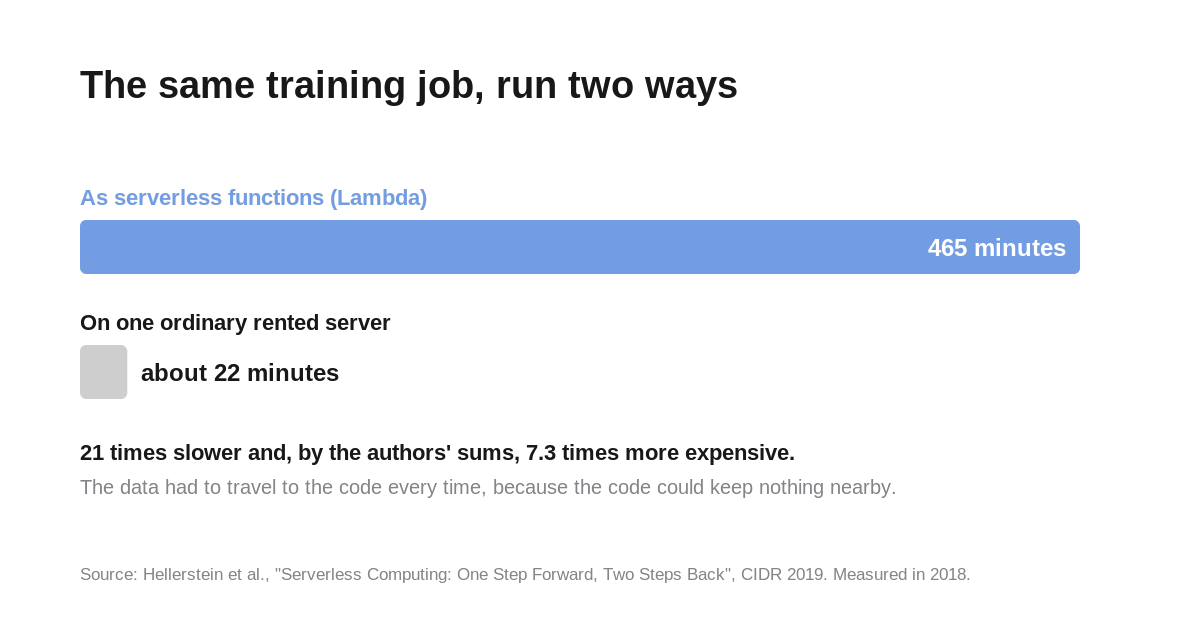
I enjoy pairing these two UC Berkeley papers because they reach seemingly opposite verdicts on serverless computing, even though several of their authors overlap.
One Step Forward, Two Steps Back by Hellerstein and colleagues, released in late 2018, critiques the first generation of cloud function services. A Berkeley View on Serverless Computing by Jonas and colleagues, published in February 2019, predicts that serverless execution will come to dominate cloud computing.
Reading them together clarifies more than treating them as a debate to award to one side.
The core promise of serverless is straightforward: a developer supplies work while the platform manages capacity and bills for actual execution. A stateless, short-lived function is one interface for delivering that promise, though far from the only possible one.
The 2018 critique asks what happens when an application has to keep state close to compute or coordinate workers across a network. First-generation function platforms made both painful. Isolated invocations exchanged intermediate state through slow object storage, so an abstraction that simplified deployment often multiplied data movement across the network.
The 2019 forecast accepts those flaws directly. It treats fast shared state, low-latency coordination, and predictable performance as the systems problems cloud providers must solve for serverless to outgrow event glue.
Data movement sets the bill
Take a twenty-stage pipeline that repeatedly revisits the same multi-gigabyte dataset. An interface that makes twenty isolated invocations trivial to deploy solves the easiest part of the job. The real architecture questions sit underneath: where does the dataset live between stages, can the next worker reuse a warm local copy, or can the scheduler place compute next to the bytes?
Compare that with an independent task triggered whenever an uploaded file lands in a bucket. It reads the object once, writes a small output, and exits. Nothing useful needs to survive between runs, so stateless functions fit cleanly.
Counting function invocations misses that distinction. Counting bytes moved across storage tiers exposes it immediately.
Unit economics follow the same split. Paying per millisecond of active execution eliminates idle server waste on bursty traffic, yet carries higher per-CPU pricing alongside storage request and network transfer charges. No single utilization threshold makes long-lived containers cheaper across the board. The crossover depends on how chatty the stages are and how much operational toil the engineering team would otherwise staff itself.
The useful question from both Berkeley papers is never whether functions won or lost as a category. Which operational burdens can the platform absorb, and which data access patterns does its interface penalize?
Continue in Paper Reviews
A Tighter Bound, More Mistakes
In Lamb, Torr, and Rudner's November 2026 paper on LLM judges, what caught my attention is that the tightest statistical bound comes from an adapter making…
SGLang RadixAttention: Put the Prompt Timestamp Last
Giving a language model the current timestamp is reasonable. Putting that changing timestamp on line one of a long system prompt is expensive. That is the…