FoundationDB Makes Recovery Routine
FoundationDB routes component failures through a single transaction-system recovery path instead of maintaining separate degraded modes. When a transaction process fails, the coordinator stops the active generation and recruits a replacement rather than branching into custom fallback protocols.
Recovery sits on the critical path. A single recovery path gets exercised constantly in testing and production, so the entire bet comes down to making reconfiguration fast enough to run in the foreground while client traffic waits.
In Zhou et al.'s SIGMOD 2021 paper, FoundationDB unbundles transaction management from data storage. Stateless proxies, sequencers, and conflict resolvers handle versions and commits alongside durable transaction logs, while separate storage servers hold versioned key-value ranges. Where Google Spanner relies on TrueTime clocks to bound global commit order across shards, FoundationDB assigns versions from a single recruited sequencer tier on commodity servers, so reconfiguring that tier never requires rebuilding the stored dataset.
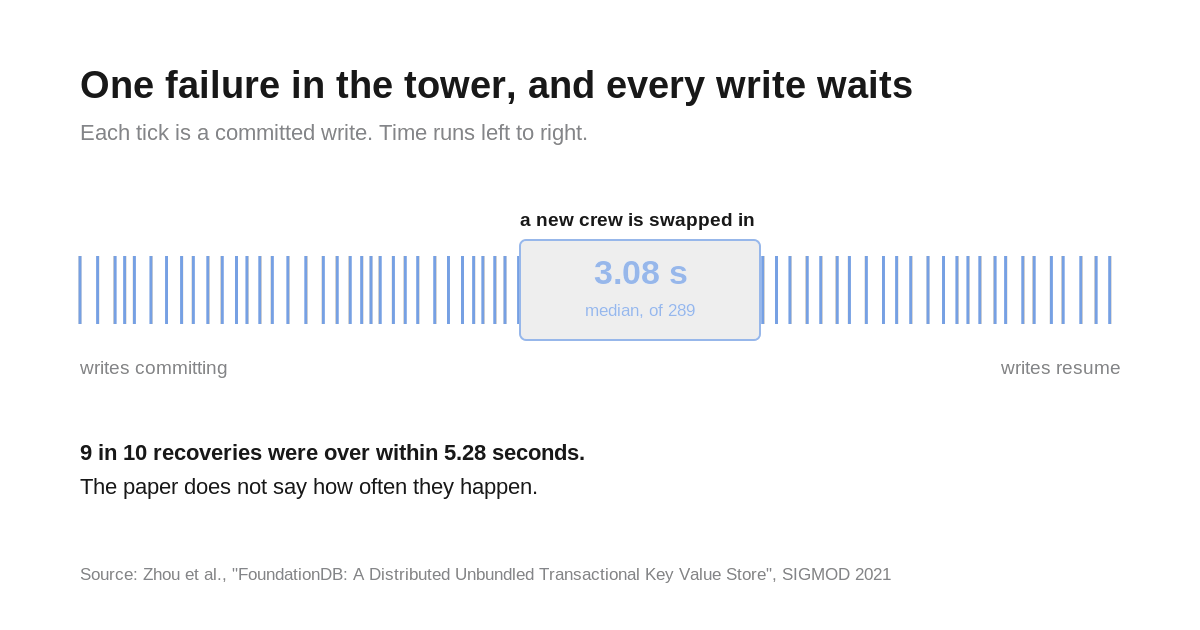
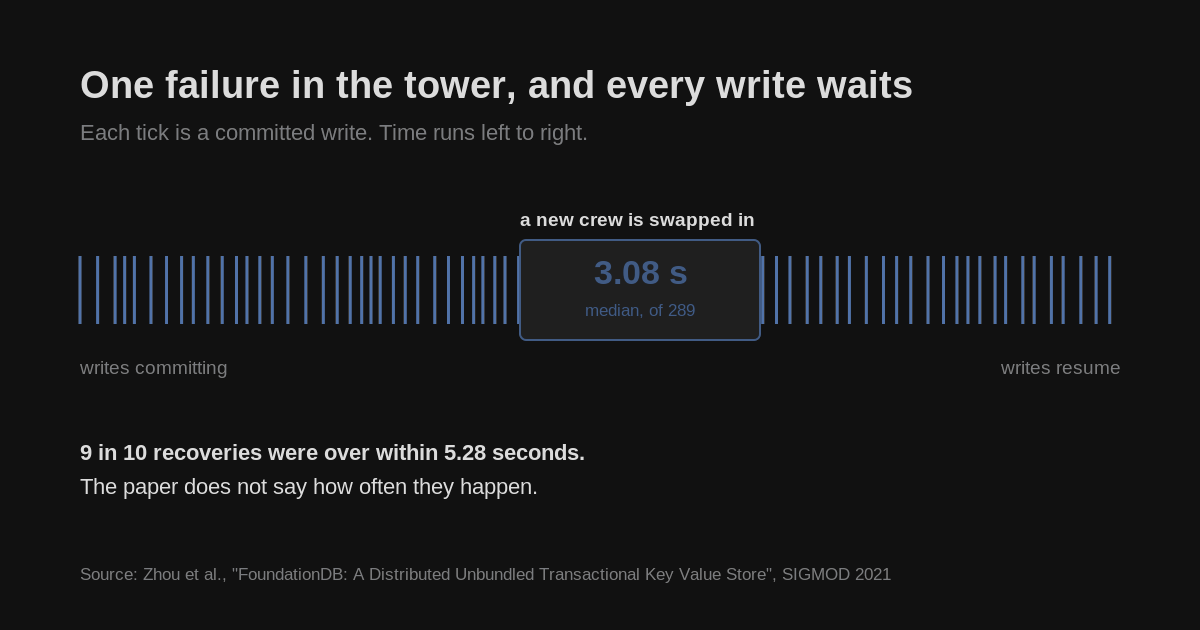
Across 289 production reconfiguration traces reported in Section 5.3, median recovery took 3.08 seconds and the 90th percentile took 5.28 seconds. Read-write transactions paused during that window, while reads served directly from storage nodes continued without interruption. Saying "the database freezes" misses that read isolation, while claiming "callers never notice" ignores client timeouts.
Two callers hit the same three-second write pause with opposite results. A background queue worker with ten seconds of retry headroom commits once the new generation opens. An interactive checkout request with a two-second deadline fails before recovery finishes.
What stays with me is how collapsing failure modes keeps the transaction protocol small enough to verify thoroughly. In exchange, client timeout budgets and retry policies become part of the storage contract. Fast recovery is the design choice that lets normal processing stay simple.
Continue in Paper Reviews
A Tighter Bound, More Mistakes
In Lamb, Torr, and Rudner's November 2026 paper on LLM judges, what caught my attention is that the tightest statistical bound comes from an adapter making…
SGLang RadixAttention: Put the Prompt Timestamp Last
Giving a language model the current timestamp is reasonable. Putting that changing timestamp on line one of a long system prompt is expensive. That is the…