An Update Without a Training Run
A support team publishes a revised refund policy at 5:00 p.m., and ten minutes later the customer assistant still quotes the old rule.
Before blaming the language model's weights, an engineer has three concrete places to inspect. Did the updated document land in the search index, did the retriever rank it near the top, and did the generator follow what was retrieved?
Separating parametric memory from external documents is the central contribution of Lewis and colleagues in the 2020 retrieval-augmented generation paper. Instead of baking every changing fact into model parameters, RAG pairs a dense passage retriever over an external index with a sequence-to-sequence generator conditioned on the retrieved passages.
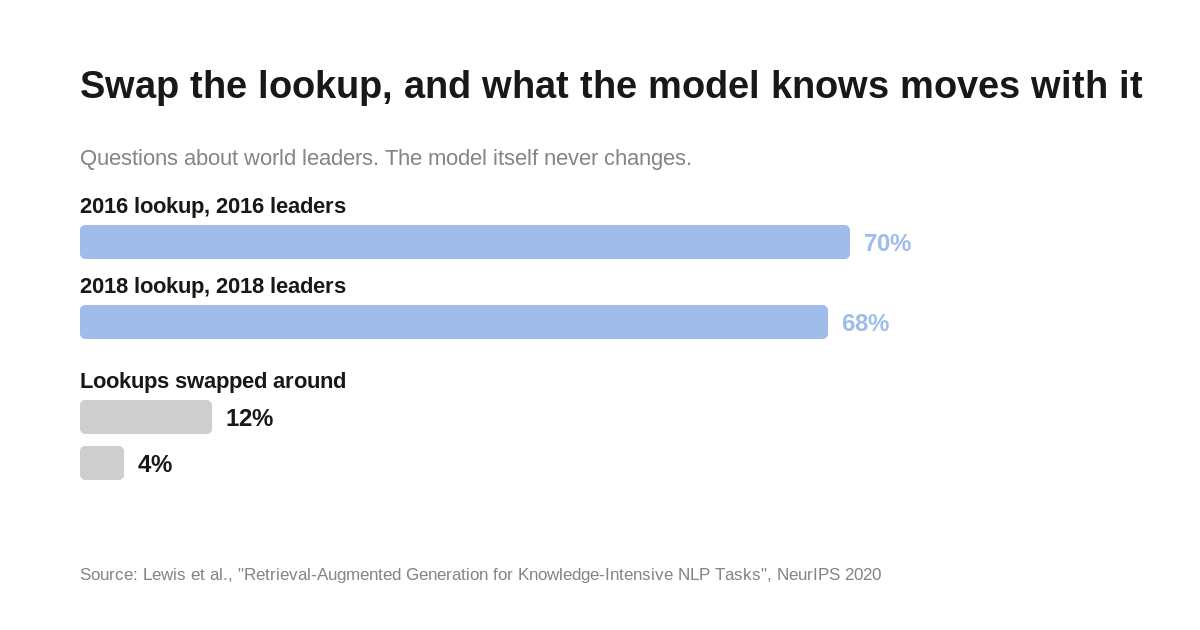
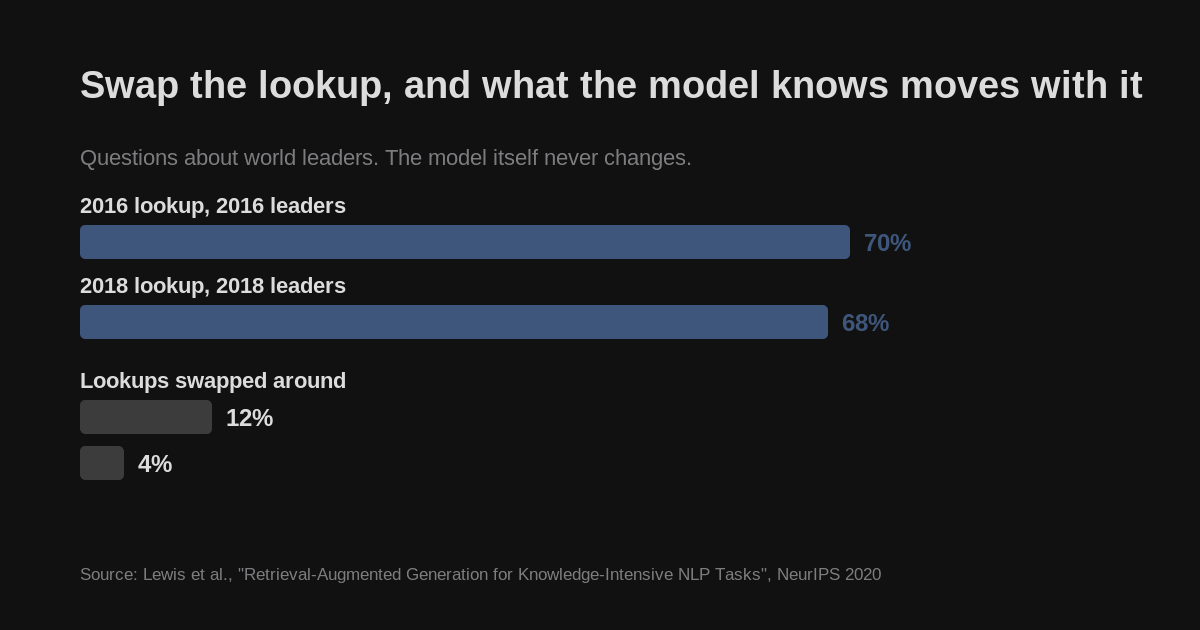
To test hot-swappable knowledge, the authors queried 82 world-leader facts against two Wikipedia snapshots without retraining the model. Paired with a December 2016 index, the system scored 70% accuracy on 2016 officeholders. Swapped to a December 2018 index, it scored 68% on 2018 officeholders, while mismatched year indexes dropped to 12% and 4%. Operational updates become index refreshes rather than training runs.
Inside the architecture, a neural query encoder maps incoming questions into vectors matched against a precomputed document index, and training updates the query encoder and generator jointly while keeping the document encoder fixed.
In production systems, vector similarity alone rarely settles temporal rules. Asking for the "current policy" could mean the latest edited draft, the terms currently in effect today, or the policy active on the date a customer placed their order. Dense embeddings retrieve topically close prose, so document metadata, effective dates, and explicit filtering have to enforce business rules before generation starts.
Retrieval also leaves provenance ambiguous unless you check it directly. Lewis and colleagues note that RAG occasionally generated the right factual answer even when no retrieved passage contained it, drawing from pretrained weights instead.
Parametric fallback helps on open-domain trivia and hurts on strict policy questions. When the applicable document is missing from the retrieved context, abstaining beats improvising a plausible rule, and displaying a citation link next to an answer only builds trust if the cited paragraph actually states the claim.
When I review a retrieval pipeline, testing a knowledge update comes down to two targeted checks whenever a source document changes: ask a question whose answer flipped between versions to verify both retrieval rank and faithfulness, and ask an out-of-scope question to confirm the system declines to guess.
Continue in Paper Reviews
A Tighter Bound, More Mistakes
In Lamb, Torr, and Rudner's November 2026 paper on LLM judges, what caught my attention is that the tightest statistical bound comes from an adapter making…
SGLang RadixAttention: Put the Prompt Timestamp Last
Giving a language model the current timestamp is reasonable. Putting that changing timestamp on line one of a long system prompt is expensive. That is the…