2 Passes in 200 on Codex HumanEval
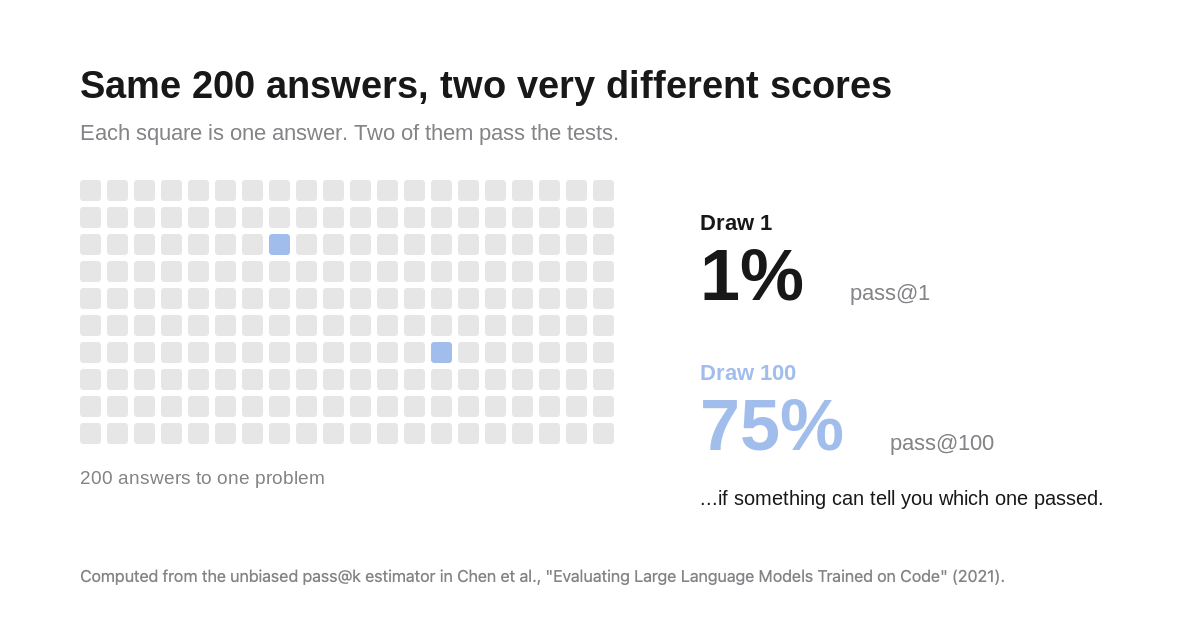
When a code model generates 200 candidate programs for one problem and two pass the unit tests, single-draw accuracy is 1%, a gap I still keep in mind whenever teams quote pass@k. Draw 100 distinct candidates from that same pool, and the probability that at least one passes jumps to roughly 75.1%.
Both numbers describe the exact same 200 outputs. They measure different events.
Counting the failure case makes the math immediate. Missing both valid programs means leaving both behind in the unpicked 100 candidates, which happens with probability 100/200 times 99/199, or about 24.9%. Every other 100-sample subset contains at least one working solution.
That combinatorics sits behind the unbiased pass@k estimator in the Codex HumanEval paper. Rather than plugging an empirical 1% pass rate into 1 - 0.99^100, which Chen and colleagues show introduces high-variance bias on small sample budgets, the estimator counts k-sized subsets directly across a larger generated pool and averages across the 164 HumanEval problems.
For anyone shipping a coding assistant, the gap between pass@1 and pass@100 points straight to candidate selection. Knowing a working patch exists somewhere inside a hundred completions helps a developer only if the product can surface that patch without dumping ninety-nine broken diffs into their editor.
In HumanEval, held-out unit tests act as an oracle filter that production requests rarely include up front. Evaluating a coding tool requires tracking two separate numbers: whether the sampled candidate pool contains a valid fix, and whether the ranking or self-test step actually delivers it to the caller. Sampling more completions lifts the first metric long before it improves the second.
Source: Chen et al., Evaluating Large Language Models Trained on Code (2021).
Continue in Paper Reviews
A Tighter Bound, More Mistakes
In Lamb, Torr, and Rudner's November 2026 paper on LLM judges, what caught my attention is that the tightest statistical bound comes from an adapter making…
SGLang RadixAttention: Put the Prompt Timestamp Last
Giving a language model the current timestamp is reasonable. Putting that changing timestamp on line one of a long system prompt is expensive. That is the…