DPO Removes a Training Loop
Preference datasets start with a prompt, two candidate completions and a human label choosing one answer over the other.
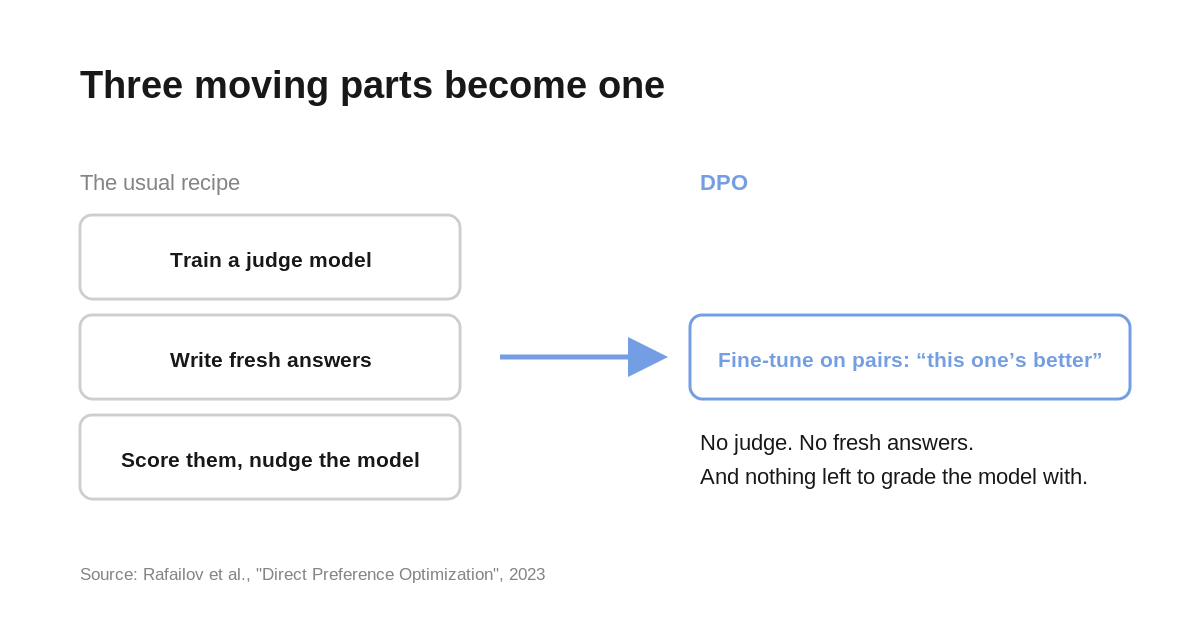
Standard RLHF pipelines turn those pairwise comparisons into two sequential optimization stages: first fit a separate reward model on the human rankings, then run online reinforcement learning (typically PPO) where the policy generates fresh completions, queries the reward model and stays tethered to a frozen reference policy via a KL penalty. Keeping actor, critic, reference and reward models stable in distributed GPU memory is notoriously finicky engineering work.
Rafailov et al.'s Direct Preference Optimization (NeurIPS 2023) collapses that multi-model RL loop into a single closed-form cross-entropy loss directly over the policy and a frozen reference model.
Follow the relative log-probabilities on a single training pair to see why it works. Take a prompt where the frozen reference model assigns completion A ten times the probability of completion B, and annotators prefer A. When the updated policy assigns A twenty times the probability of B, its implicit reward ratio in favor of A has doubled relative to the reference baseline.
Under the Bradley-Terry preference model and the KL-constrained reward-maximization objective, the optimal policy and the underlying reward function have an exact analytical mapping up to a prompt-dependent partition function. Because DPO compares two completions to the exact same prompt, that intractable partition term cancels cleanly out of the difference.
What remains is a supervised-looking binary classification loss over sequence log-probabilities, weighted dynamically so pairs where the policy currently ranks the rejected answer above the chosen answer receive stronger gradient updates. Offline DPO never samples autoregressively inside the inner training loop or fits a standalone reward network.
To me, simplifying the optimizer is a genuine infrastructure win, because fewer moving parts mean fewer hyperparameters and memory bottlenecks hiding alignment bugs. Just remember what the math cannot fix: DPO optimizes faithfully toward whatever biases live inside your preference pairs. When annotators routinely favor confident, verbose formatting or terse summaries that omit edge cases, a cleaner loss function simply teaches that habit more efficiently.
Continue in Paper Reviews
A Tighter Bound, More Mistakes
In Lamb, Torr, and Rudner's November 2026 paper on LLM judges, what caught my attention is that the tightest statistical bound comes from an adapter making…
SGLang RadixAttention: Put the Prompt Timestamp Last
Giving a language model the current timestamp is reasonable. Putting that changing timestamp on line one of a long system prompt is expensive. That is the…