The Cars Already on Their Way
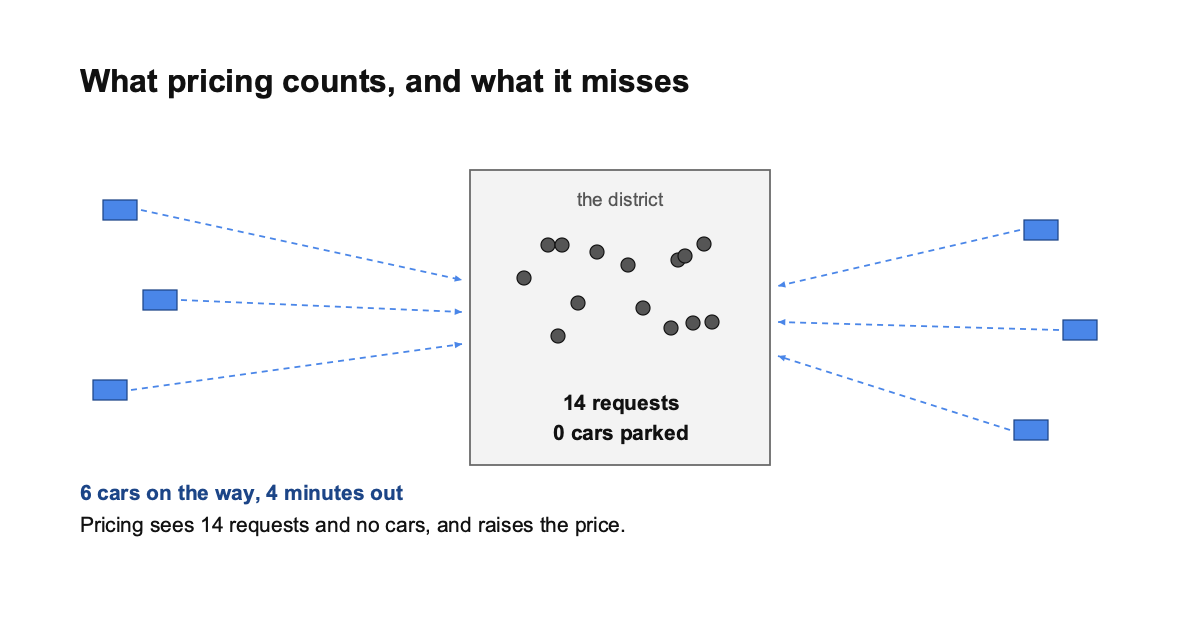
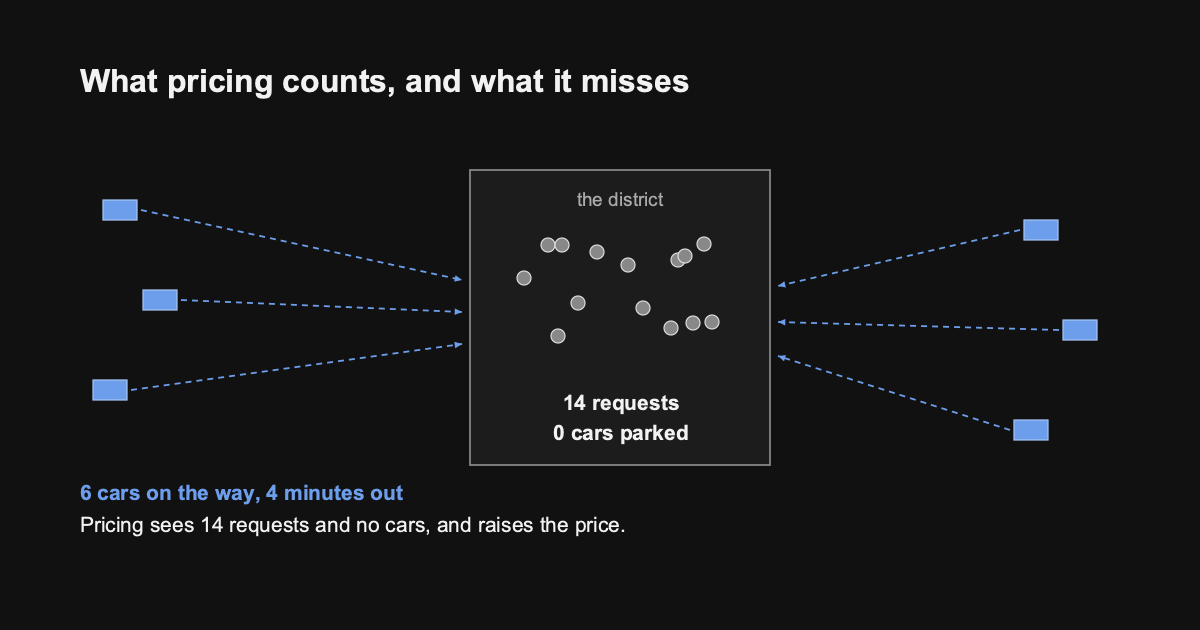
Six driverless cars sit eight minutes outside a busy district. A point-in-time pricing loop counts zero idle cars inside the zone and raises fares.
In an autonomous ridehail marketplace, a fleet controller repositions idle vehicles toward anticipated demand while dynamic pricing rations local shortages. When those two controllers read separate snapshots of supply, pricing prices away the very riders the incoming vehicles were dispatched to pick up.
Pricing and repositioning act at different speeds
Autonomous fleets change one core assumption from classic human-driven ridehail economics. Over a fifteen-minute spike with a fixed active fleet on the road, raising fares cannot entice off-duty human drivers to log on from home. Short-horizon pricing shapes rider conversion and allocates scarce pickup capacity toward higher-urgency trips, whereas fleet repositioning physically moves supply across the map at street speed.
Counting 'available cars in hex cell X right now' therefore misstates real supply. A parked vehicle two blocks away, an occupied vehicle dropping off around the corner in ninety seconds, and an empty vehicle cruising inbound six minutes out represent very different supply curves over the next pickup window. Availability also depends on battery state of charge, cleaning or maintenance holds, and operational-design-domain routing rules that restrict which streets or turns an autonomous vehicle can take.
Prior ridehail marketplace research shows why uncoordinated local loops go sideways fast. Hall, Kendrick and Nosko's Uber surge study analyzes how price spikes ration rider demand alongside driver supply shifts during event surges. Castillo, Knoepfle and Weyl show how matching riders to distant vehicles burns fleet time in empty 'wild goose chase' pickups and deepens the local shortage. In an autonomous fleet where every empty mile also spends battery capacity and depot turnaround budget, over-reacting in both loops compounds quickly.
Separating arrival from commitment
Coupling pricing and fleet positioning starts with a shared spatiotemporal availability state across future time buckets rather than independent point-in-time counters. Pricing evaluates net expected supply over the rider's acceptable wait window, while repositioning optimizes against post-price expected demand rather than raw unpriced app opens.
Forecasting physical arrival is only half the contract. Ledger accounting has to separate unencumbered incoming supply from already-promised capacity. Once dispatch commits an inbound car to a specific rider or reserves it for a charging slot, downstream pricing calls cannot keep counting that vehicle as slack supply for the neighborhood. Conversely, when dispatch diverts an inbound repositioning car to cover an adjacent zone, the destination zone's forward supply ledger has to decrement immediately so two controllers never spend the same vehicle twice.
Sharing one bad ETA model across both controllers creates correlated risk of its own. When downtown congestion slows inbound travel times unexpectedly, under-predicting arrival delay can cause pricing to under-price a genuine shortage while dispatch simultaneously starves neighboring zones. Carrying arrival-time uncertainty explicitly prevents brittle point estimates from driving aggressive swings, and quoting riders a lower fare in exchange for a longer pickup window creates an explicit SLA that dispatch has to honor.
Stress-testing coupled marketplace loops
When I look at marketplace control loops, state consistency comes before tuning policy weights under mid-flight preemption: divert two inbound repositioning vehicles four minutes before arrival and trace how many seconds elapse before quote pricing, ETA display and next-step repositioning reflect the lost supply. Optimizing ML policies only pays off once pricing and dispatch agree on which cars are actually free to serve the next ride.
Continue in AI Architecture & Agents
Save the Failing Run
Last Christmas I built a coding agent from scratch to read a spec, plan repository edits, run tests, and recover when checks failed. Single tool calls were…
Before You Show Me the Token Chart
I am glad to fund engineers exploring what AI tools can do, knowing upfront that plenty of those experiments will hit dead ends. Demanding a guaranteed ROI…