How DeepSeek Shares the Work
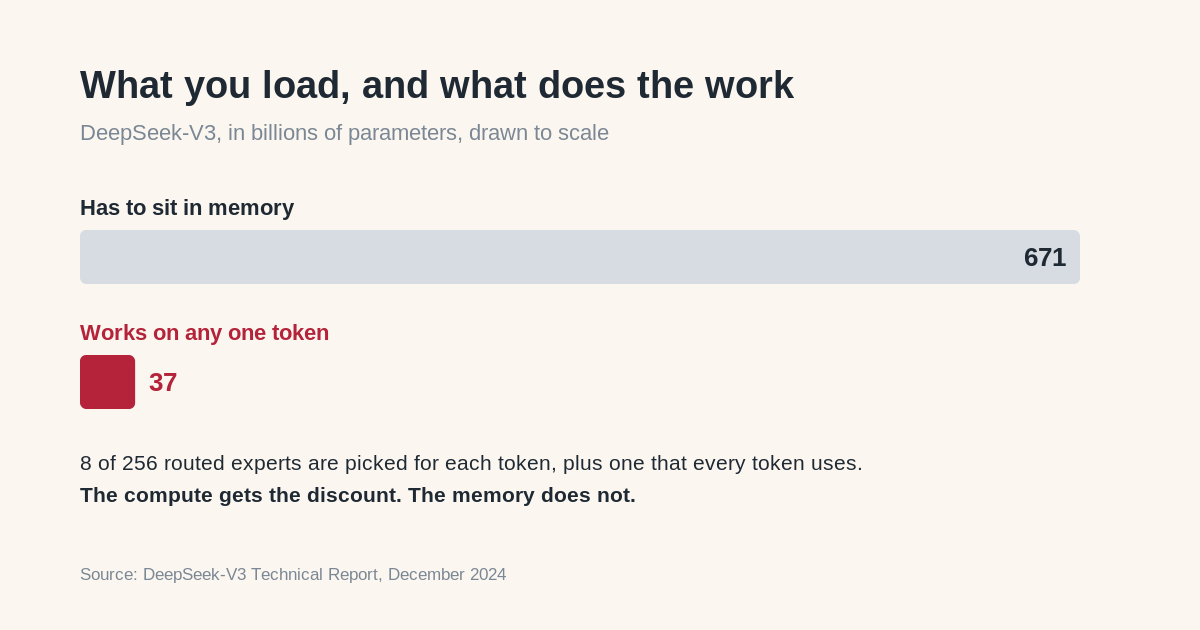
Routing every token to its highest-scoring experts leaves a mixture-of-experts model with hot shards and idle GPUs. Popular experts bottleneck training throughput while underused ones waste memory bandwidth.
In the DeepSeek-V3 technical report, each MoE layer activates 8 of 256 routed experts alongside one shared expert, engaging 37 billion of the model's 671 billion parameters per token. Instead of penalizing router imbalance with a heavy auxiliary loss that competes with next-token prediction, DeepSeek adds a learned per-expert bias term strictly during top-k selection.
Selecting two out of three experts shows how selection decouples from combination:
| Expert | Affinity score | Load bias | Selection score |
|---|---|---|---|
| A | 0.90 | -0.20 | 0.70 |
| B | 0.80 | 0.00 | 0.80 |
| C | 0.75 | +0.10 | 0.85 |
Unbiased routing picks A and B. Adding the load bias shifts the slot to C and B because A is overloaded.
Once B and C win the execution slots, the bias drops out. Their outputs combine using normalized weights from the original affinity scores (0.80 and 0.75), so the congestion nudge that admitted expert C never inflates how strongly C speaks in the layer output.
After each training step, the controller inspects batch token counts, nudging overloaded expert biases down and underloaded biases up. Although DeepSeek calls the design auxiliary-loss-free, the full training run still retains a tiny sequence-level balance loss to guard against extreme single-sequence skew.
To me, splitting admission control from combination weights is clean systems engineering inside neural routing. Parameter counts tell you how many flops MoE skips, while that two-stage router explains how the cluster actually stays busy. Where else have you seen admission pricing separated cleanly from downstream scoring?
Continue in Paper Reviews
A Tighter Bound, More Mistakes
In Lamb, Torr, and Rudner's November 2026 paper on LLM judges, what caught my attention is that the tightest statistical bound comes from an adapter making…
SGLang RadixAttention: Put the Prompt Timestamp Last
Giving a language model the current timestamp is reasonable. Putting that changing timestamp on line one of a long system prompt is expensive. That is the…