Which Calls Should a Person Check?
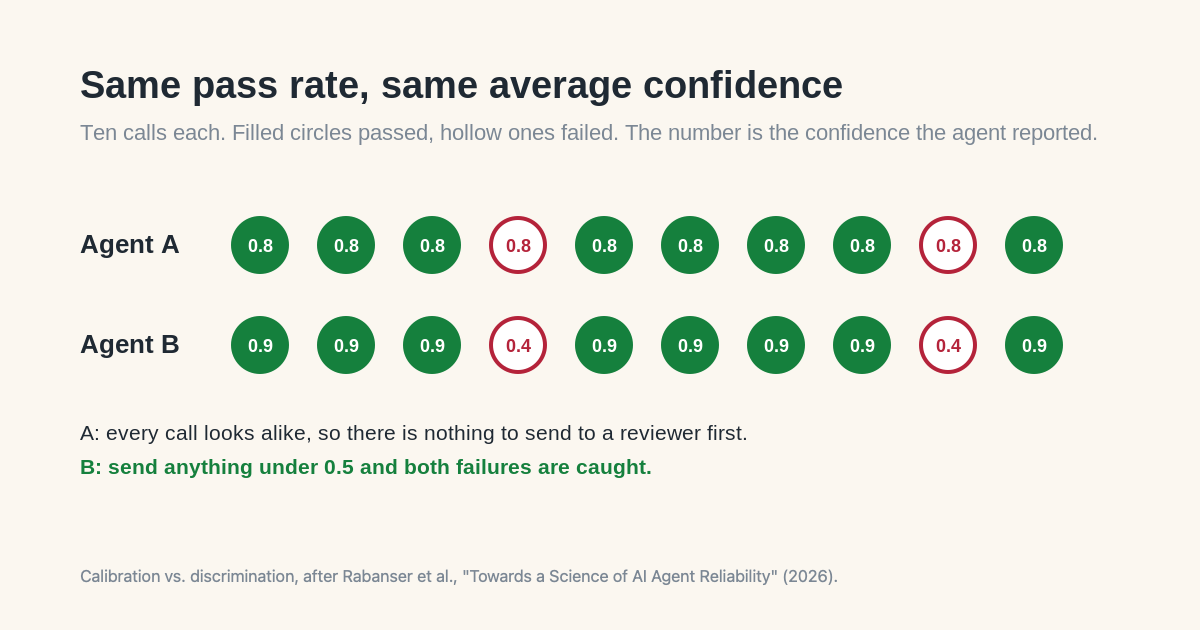
Two agents each run ten tasks and succeed on eight. With reviewer bandwidth for only two checks, which two runs belong in the human queue?
Compare their reported confidence scores across those ten completed tasks:
| Agent | Confidence on eight passes | Confidence on two failures | Mean confidence |
|---|---|---|---|
| A | 80% | 80% | 80% |
| B | 90% | 40% | 80% |
Both agents hit the exact same accuracy and report the exact same 80% mean confidence. For an operations team triaging work, one score is useless and the other is a routing signal.
Agent A stamps 80% on every output, leaving reviewers guessing at random. Agent B ranks both failures at the bottom of the batch, so inspecting its two lowest-confidence runs catches every mistake.
Calibration versus discrimination
Flip the question to ask whether reported probabilities match empirical pass rates, and the winner reverses. Agent A's flat 80% matches its 8-of-10 batch pass rate. Agent B's buckets overshoot in opposite directions: its 90% group passed every time, and its 40% group failed every time.
Statistical evaluation separates those two properties cleanly. Calibration asks whether a 70% score succeeds roughly seven times in ten. Discrimination asks whether higher scores reliably outrank lower ones when separating passes from failures.
Keeping those properties distinct is the sharpest contribution in Towards a Science of AI Agent Reliability. Evaluating 15 models across GAIA and tau-bench, the authors decompose reliability into twelve metrics across four pillars: consistency, robustness, predictability, and safety. Calibration and discrimination live inside predictability, forcing product teams to name which guarantee a workflow actually consumes instead of hiding behind a single pass-rate headline.
Blind spots in an escalated review queue
Turning discrimination into a production escalation gate takes held-out data that never touched threshold selection. Even a well-separated validation curve runs into a feedback trap once deployed: when reviewers inspect only low-confidence escalations, high-confidence silent failures disappear from labeled logs.
Drawing a small random audit sample from auto-accepted traffic keeps that blind spot measurable, provided irreversible actions sit behind stricter deterministic gates first.
While the paper uses AUROC to summarize ranking quality across every possible cutoff, a live queue operates at one specific capacity ceiling. An impressive overall AUROC can still leave high-severity mistakes clustered just above your chosen review cutoff, and confidence scores never substitute for authorization rules on destructive writes.
I treat repeat-run consistency as its own axis too. An agent that takes two valid tool paths to reach the right answer is fine, whereas an agent that deterministically books an invoice against the wrong ledger every single run is consistent in the worst possible way. When your teams review agent evals, do their dashboards separate aggregate pass rate from queue-routing discrimination?
Continue in Paper Reviews
A Tighter Bound, More Mistakes
In Lamb, Torr, and Rudner's November 2026 paper on LLM judges, what caught my attention is that the tightest statistical bound comes from an adapter making…
SGLang RadixAttention: Put the Prompt Timestamp Last
Giving a language model the current timestamp is reasonable. Putting that changing timestamp on line one of a long system prompt is expensive. That is the…