Google Bigtable: Locality Groups Over Schema Enforcement
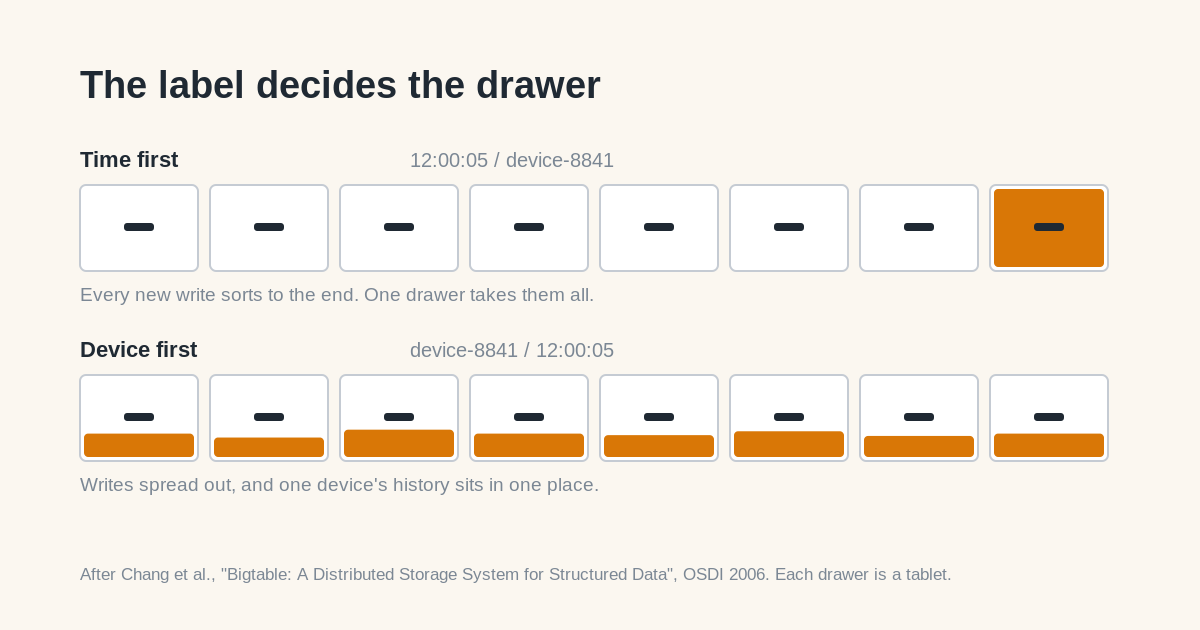
Choosing what comes first in a Bigtable row key decides which product query gets a fast contiguous scan and which one fans out.
Put two everyday fleet-monitoring queries side by side before picking a schema:
- Show the last 24 hours of telemetry from device
8841. - Show the last hour of telemetry across every active device.
Both look like simple WHERE clauses on a sensor table. On an ordered key-value store, they pull storage layout in opposite directions.
Chang and colleagues explain in the 2006 Bigtable paper that rows stay lexicographically sorted by row key, split dynamically into contiguous key ranges called tablets across servers. Row-key prefix order dictates physical locality. In Google's Webtable example, reversing domain names (com.cnn.www instead of www.cnn.com) clustered pages from the same host onto adjacent tablet blocks for compression and range scans.
Apply that sorting rule to device telemetry:
| Row-key prefix | Query served by a contiguous range scan |
|---|---|
device_id#timestamp |
One device's history over a time window |
timestamp#device_id |
Fleet-wide readings inside a time slice |
Putting device_id first makes rendering one device's diagnostic timeline a tight range read while scattering the fleet's latest hour across every tablet. Putting timestamp first groups the fleet's latest hour together, at the cost of funneling every incoming write onto the single tablet holding the current clock edge.
My favorite schema reviews force the product conversation right here: which screen blocks a live operator, and which report runs asynchronously? Adding a secondary index table buys fast reads for both patterns at the price of dual-write amplification and reconciliation when one write fails, since Bigtable guarantees atomicity within a single row key rather than across rows. That multi-row transaction gap is the exact constraint Google later addressed with Paxos groups and TrueTime commit wait in Spanner.
Long before anyone tunes block caches or SSTable compaction, ordering the segments inside a string key has already picked which product feature stays cheap and which one hurts at scale.
Source: Chang et al., Bigtable: A Distributed Storage System for Structured Data, OSDI 2006.
Continue in Paper Reviews
A Tighter Bound, More Mistakes
In Lamb, Torr, and Rudner's November 2026 paper on LLM judges, what caught my attention is that the tightest statistical bound comes from an adapter making…
SGLang RadixAttention: Put the Prompt Timestamp Last
Giving a language model the current timestamp is reasonable. Putting that changing timestamp on line one of a long system prompt is expensive. That is the…