Spanner Waits Out Its Own Doubt
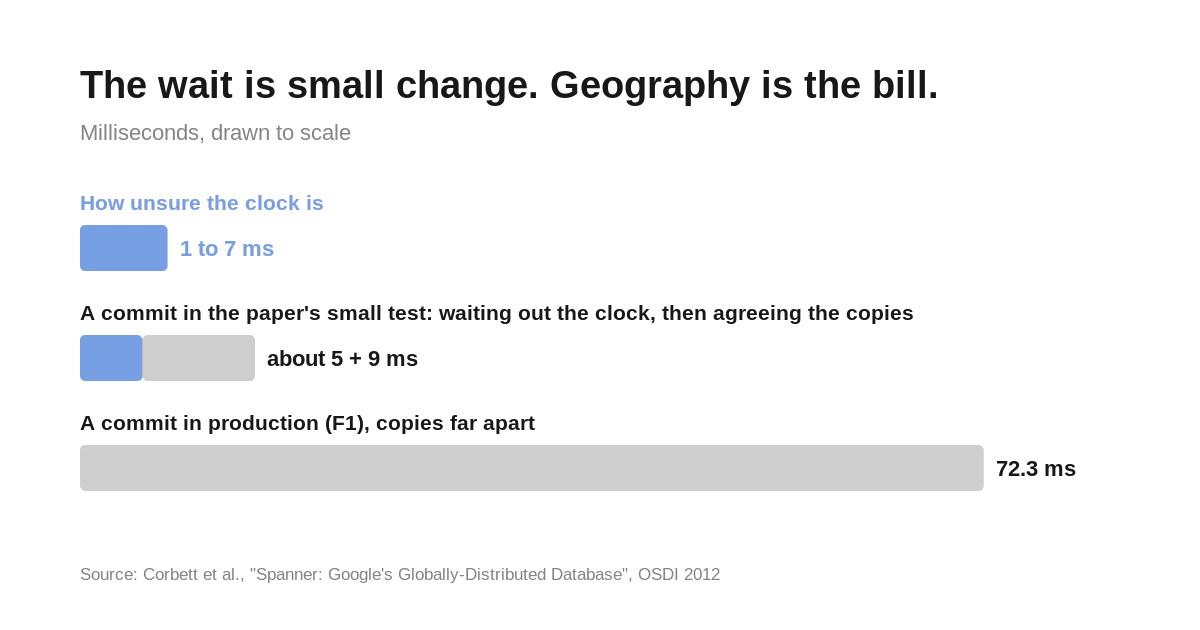
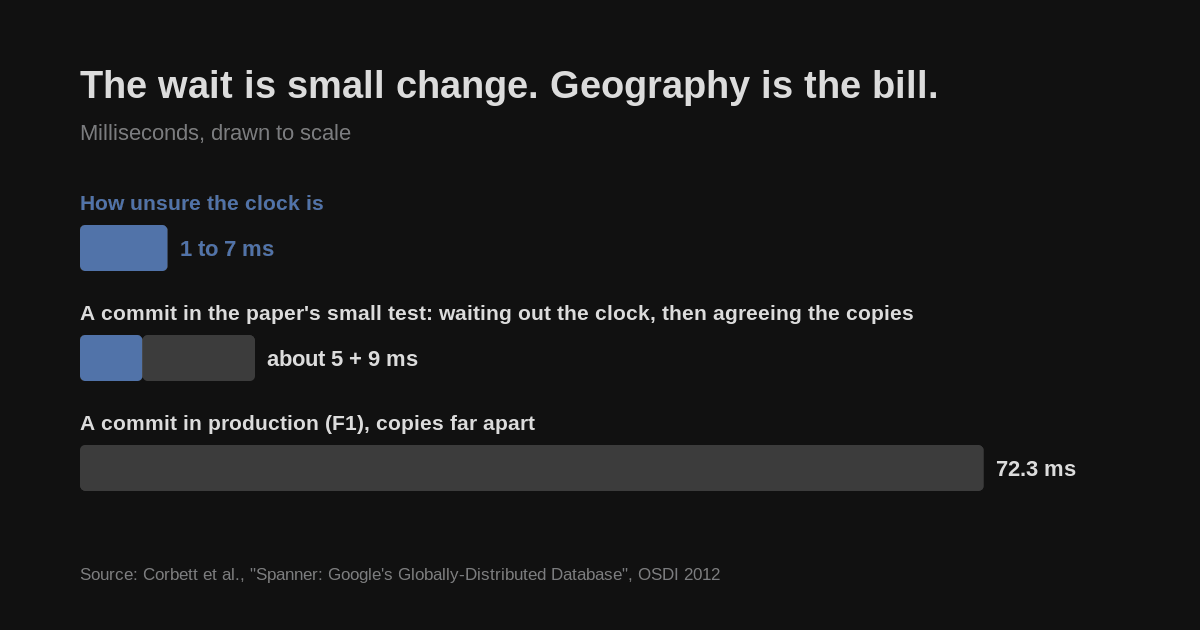
TrueTime answers 'What time is it?' with a bounded time interval, and what I admire in Google's Spanner is how it makes that uncertainty part of the transaction protocol.
Walk through two TrueTime readings in milliseconds to see how the guarantee works. On the first call, TT.now() returns [100, 110]. When a coordinator picks 110 as a write transaction's commit timestamp, the system cannot release the transaction's results yet because actual physical time might still be 102.
Moments later, another call returns [111, 121]. Because even the earliest bound now sits past 110, timestamp 110 lies strictly in the past as long as TrueTime's error bound holds.
That pause is Spanner's commit wait. Holding visibility until the assigned timestamp is guaranteed to have passed, paired with monotonic timestamp rules on Paxos leaders and two-phase commit coordinators, delivers external consistency: whenever transaction T2 starts in real wall-clock time after T1 finishes committing, T2 receives a strictly larger timestamp and sees T1's writes.
TrueTime's [earliest, latest] window is a hardware-and-daemon error bound backed by GPS receivers and atomic clocks across datacenters, not a soft statistical heuristic. Wider clock uncertainty stretches commit wait linearly and degrades write latency, whereas violating the bound silently breaks external consistency.
Atomic clocks do not replace distributed consensus either. Every shard still replicates writes through Paxos groups, and cross-group writes still run two-phase commit across group leaders. TrueTime lets read-only transactions read at a safe timestamp across shards completely lock-free without running global consensus on every read.
What stands out architecturally is how cleanly the API encodes physical reality. Exposing clock uncertainty epsilon explicitly lets the storage engine turn better timekeeping hardware directly into shorter commit waits, and overlaps much of that wait with Paxos replication round-trips so writers rarely pay the wait purely in serial.
Carry away the two intervals [100, 110] and [111, 121]. In the first, 110 might still lie ahead. In the second, 110 is guaranteed to lie behind. Spanner turns that physical clock guarantee into lock-free globally consistent snapshots.
Source: Corbett et al., Spanner: Google's Globally Distributed Database, ACM TOCS 2013 / OSDI 2012.
Continue in Paper Reviews
A Tighter Bound, More Mistakes
In Lamb, Torr, and Rudner's November 2026 paper on LLM judges, what caught my attention is that the tightest statistical bound comes from an adapter making…
SGLang RadixAttention: Put the Prompt Timestamp Last
Giving a language model the current timestamp is reasonable. Putting that changing timestamp on line one of a long system prompt is expensive. That is the…