What Does '8 TP, 4 PP, 16 DP' Actually Divide?
A training plan labeled '8-way tensor parallelism, 4-way pipeline parallelism, 16-way data parallelism' describes sixteen cooperating 32-GPU replicas. Each replica spans four pipeline stages, with eight GPUs splitting every layer inside a stage.
Multiplying 8 x 4 x 16 gives 512 GPUs, yet those 512 accelerators play three very different roles on the network fabric.
The enduring contribution of NVIDIA's Megatron-LM papers is showing how intra-layer, inter-layer and batch-level partitioning compose cleanly once a single transformer outgrows one node's HBM capacity.
Tensor parallelism inside a layer
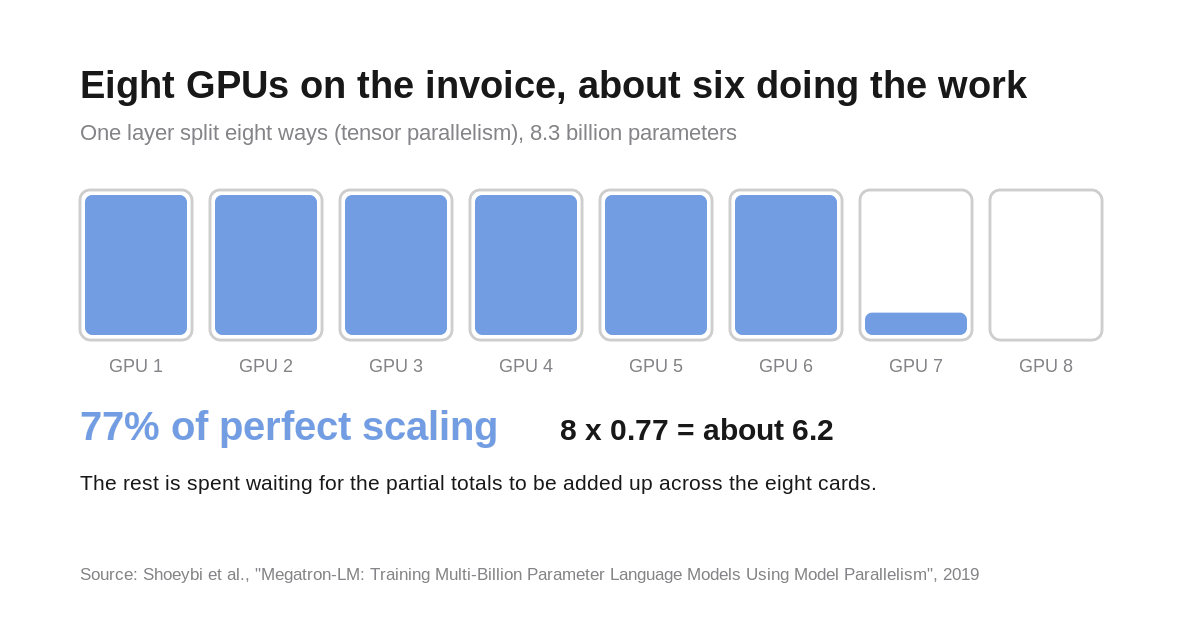
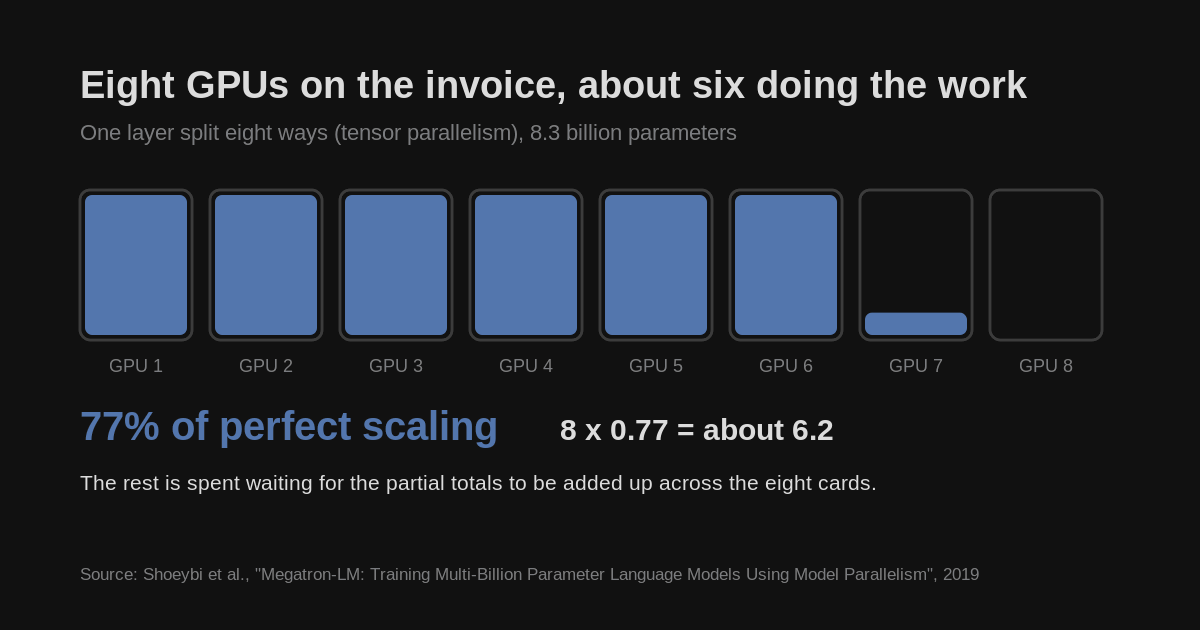
Tensor parallelism splits individual matrix multiplications inside a transformer block across multiple GPUs. Megatron partitions MLP weight matrices column-wise in the first projection and row-wise in the second, letting GeLU activations run locally before synchronizing partial sums with an all-reduce in the forward and backward passes.
Because every transformer layer triggers tight collective communication on the critical path, tensor-parallel ranks demand ultra-high-bandwidth, low-latency interconnects like intra-node NVLink. Stretching eight-way tensor parallelism across slow inter-node Ethernet stalls compute units waiting on activations, even when every GPU has plenty of free memory.
Pipeline stages across layers
Pipeline parallelism slices the stack of transformer layers sequentially across nodes so stage 0 runs early layers, passes activations across the network to stage 1, and continues through stage 3.
Splitting a batch into smaller microbatches keeps multiple pipeline stages busy simultaneously rather than leaving three-quarters of the cluster idle on a single forward pass. Pipeline bubbles at step boundaries and uneven memory pressure from input embeddings or output logits still require careful schedule tuning (such as interleaved 1F1B schedules), because equal layer counts per stage rarely produce identical compute or memory footprints.
Together, the 8-way tensor group and 4-way pipeline chain form one complete 32-GPU model replica.
Data replicas across batches
Data parallelism duplicates that 32-GPU model topology sixteen times, feeds each replica distinct training microbatches, and averages gradients across corresponding ranks at the step boundary. Plain data parallelism scales token throughput without shrinking per-GPU parameter memory, which is why modern stacks often pair it with ZeRO-style optimizer-state sharding across the data-parallel group.
Reading 8 TP, 4 PP, 16 DP as a network topology map rather than a headcount of GPUs made cluster topology click for me: NVLink inside the 8-GPU node for tensor collectives, point-to-point cross-node activation hops along the 4-stage pipeline, and periodic gradient reductions across the 16 data-parallel lanes.
Papers: Shoeybi et al., Megatron-LM (2019) and Narayanan et al., Efficient Large-Scale Language Model Training (2021).
Continue in Paper Reviews
A Tighter Bound, More Mistakes
In Lamb, Torr, and Rudner's November 2026 paper on LLM judges, what caught my attention is that the tightest statistical bound comes from an adapter making…
SGLang RadixAttention: Put the Prompt Timestamp Last
Giving a language model the current timestamp is reasonable. Putting that changing timestamp on line one of a long system prompt is expensive. That is the…