What Has to Cross Between Agents?
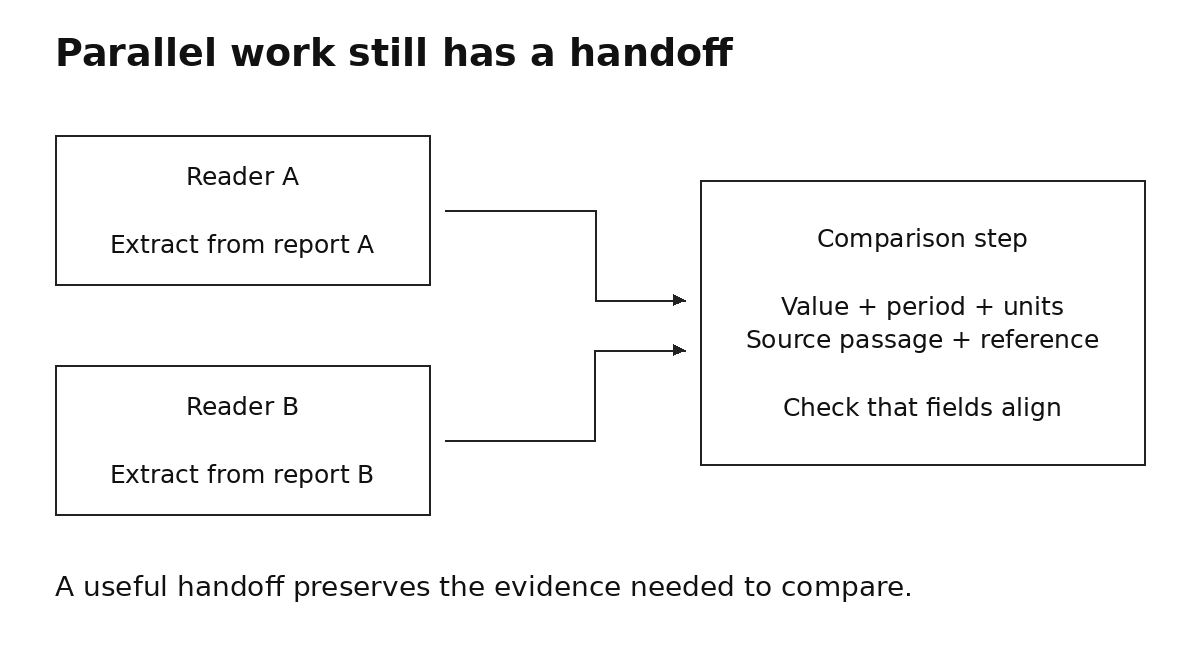
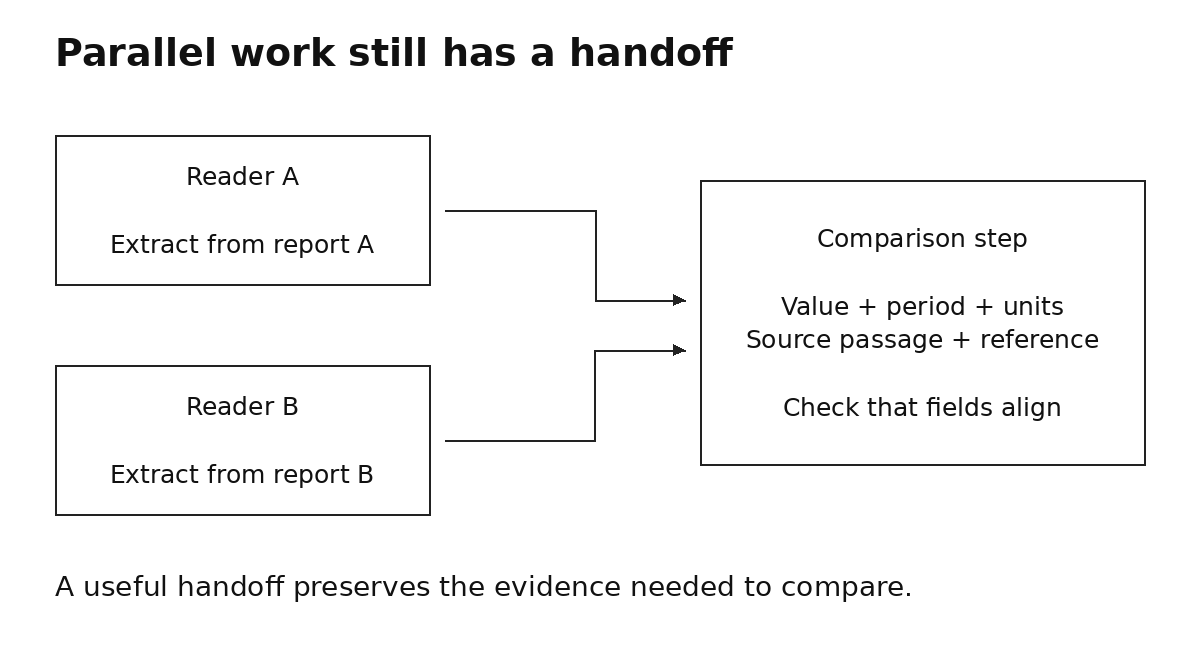
Two agents read two separate annual reports, extract revenue and reporting periods, and hand their findings to a third agent to compare.
Keep that extraction contract fixed and parallel workers save wall-clock time. Let each reader redefine the comparison metric mid-run, and one returns fiscal-year revenue while the other pulls a single quarter. The synthesizer receives two polished tables that cannot legally sit in the same ratio.
Multi-agent reliability lives or dies in the contract crossing between nodes, which is why Towards a Science of Scaling Agent Systems (Kim et al.) is worth reading closely. Instead of treating agent count as a capability knob, the authors test how coordination topologies interact with task coupling.
Schema contracts at the handoff
Splitting work pays off when each worker receives self-contained inputs and emits fields downstream consumers can verify mechanically. Asking an agent to "summarize this filing" strips away currency units and fiscal calendars, forcing the downstream synthesizer to guess.
Pinning an explicit extraction schema alongside source-page citations does not guarantee the numbers are right, yet it makes mismatches between workers immediately visible.
Real engineering workflows mix parallel and serial phases inside the same ticket. Investigating three suspect modules splits cleanly across workers, editing a shared interface is strictly sequential, and reviewing the resulting diff can branch out again. Whenever an upstream edit alters an interface signature, downstream reviewers need the committed code state rather than the planner's original wish list.
Architecture slides covered in role boxes labeled Planner, Researcher, and Critic hide the only question that matters: what exact state crosses each arrow?
Across 260 benchmark configurations
In their April 2026 revision, the authors evaluate 260 configurations spanning six benchmarks and five topologies (single agent, independent parallel workers, centralized hub-and-spoke, peer-to-peer mesh, and hybrid).
Outcomes swing sharply by workload shape. On parallelizable financial reasoning, centralized coordination beat the single-agent baseline by 80.9%. On tightly coupled sequential planning tasks, multi-agent variants degraded performance by 39% to 70% relative to a single model holding the full state in one context window.
Coordination burns token budget and fragments working memory, while extra workers add parallel search breadth and independent checks. Which force wins is an empirical property of the task's dependency graph.
The paper also observes multi-agent gains shrinking once a single frontier model already clears roughly 45% accuracy on a benchmark. I would not turn that 45% crossover into a rigid architecture rule, because aggregate pass rates hide whether a clean parallel sub-problem still exists inside the workflow.
Verification versus another model's opinion
Centralized topologies contained error amplification far better than unverified peer meshes (4.4x versus 17.2x in the authors' error-propagation analysis). Even so, a coordinator LLM nodding along to "revenue was roughly ten billion" adds zero rigor if period and currency are missing.
Deterministic schema validators verify field presence and unit compatibility, while citation checks verify that the quoted page actually contains the extracted figure. Neither check requires dressing another prompt up as a "critic."
Matched-compute academic benchmarks also omit two numbers product leaders pay for directly: p95 wall-clock wait and rework cost after a dropped handoff. When a team proposes splitting one agent into four, ask to see the handoff schema before looking at the org chart of prompts.
Continue in Paper Reviews
A Tighter Bound, More Mistakes
In Lamb, Torr, and Rudner's November 2026 paper on LLM judges, what caught my attention is that the tightest statistical bound comes from an adapter making…
SGLang RadixAttention: Put the Prompt Timestamp Last
Giving a language model the current timestamp is reasonable. Putting that changing timestamp on line one of a long system prompt is expensive. That is the…