The Retry That Keeps the Outage Going
The bad release rolled back twenty minutes ago, yet the service is still drowning. Slow requests are triggering retries that keep the queue full.
Every post-incident review eventually runs into that split. Removing the trigger that started an outage and breaking the feedback loop that sustains it are two separate engineering jobs.
Count the attempts
A backend service handles 100 units of work per second and receives 70 original requests per second at one unit per attempt.
During a brief downstream stall, queues build up until 60% of incoming requests time out and fire one retry. Those 70 user requests now generate 42 retry attempts, pushing arriving load to 112 units per second. Even after full backend capacity returns to 100 units, arriving work exceeds service capacity and the queue never drains:
| Operating state | Original load | Retry attempts | Total arriving work |
|---|---|---|---|
| Normal traffic | 70 | 0 | 70 |
| Uncapped retry on 60% of calls | 70 | 42 | 112 |
| Capped 10% retry budget | 70 | 7 | 77 |
Capping extra attempts at 10% holds total load to 77 units when healthy capacity is 100, leaving 23 units of headroom to drain the backlog. If degraded capacity drops to 60 units, 77 units still saturates the fleet, so retry budgets always pair with server-side load shedding and deadline cancellation.
Bronson et al.'s HotOS 2021 paper on metastable failures formalized why overloaded systems stay trapped in a degraded state after the initial fault clears. Follow-up empirical work in Metastable Failures in the Wild (OSDI 2022) examined 22 production postmortems across 11 organizations and found retry amplification sustaining more than half of those incidents.
Hedged requests versus retry storms
Extra attempts are not inherently wasteful. Under normal load, duplicating a straggler call can shave tail latency dramatically.
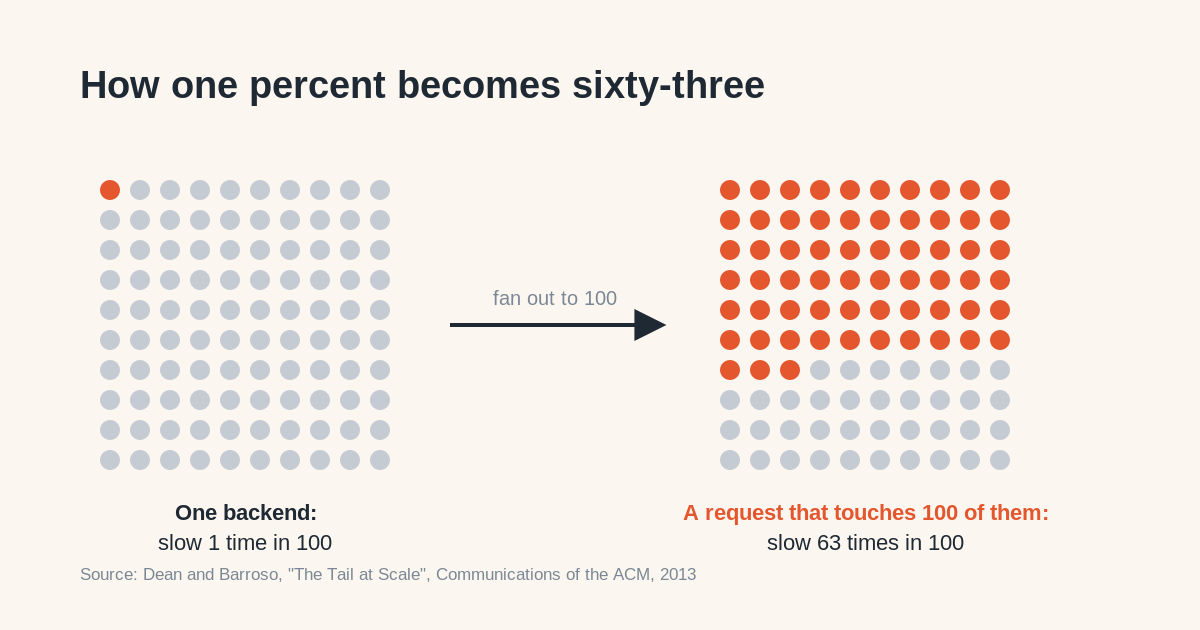
Dean and Barroso's The Tail at Scale showed why rare single-node hiccups dominate fan-out architectures: when one user request fans out across 100 independent backends that each have a 1% chance of stalling, the probability of waiting on at least one slow node hits roughly 63%. Sending a hedged request after the 95th-percentile wait rescues isolated stragglers whenever sibling replicas have spare room.
When every replica shares the same contended database or saturated network link, that hedged copy pours fuel onto the bottleneck. Isolating state into small, independent failure cells, the pattern that stood out to me in AWS Physalia's Millions of Tiny Databases, helps keep one hot partition's retry loop from starving unrelated callers across the fleet. Exponential backoff spreads retries across time without bounding total amplified work, whereas an explicit retry budget bounds volume.
In a per-process client retry token bucket, each primary request deposits 0.1 tokens while a retry spends 1.0 token and skips attempts once remaining deadline drops below median latency:
class RetryBudget:
    def __init__(self, capacity: float = 10.0) -> None:
        self.capacity, self.tokens = capacity, capacity
    def on_primary_request(self) -> None:
        self.tokens = min(self.capacity, self.tokens + 0.1)  # 10% retry cap
    def can_retry(self, deadline_remaining_ms: float, p50_ms: float) -> bool:
        if deadline_remaining_ms < p50_ms or self.tokens < 1.0:
            return False
        self.tokens -= 1.0
        return True
Marc Brooker's simulation of token-bucket retry budgets highlights an important edge case: per-client token buckets work well for long-lived service-to-service callers, whereas thousands of newly spawned short-lived clients arrive with full buckets and retry simultaneously on their very first failure.
Leaving headroom to recover
Fault-injection tests only catch metastable loops if they measure goodput recovery after the fault is removed, separating completed business operations from raw RPC attempts.
Servers have to defend themselves too. Lifo queuing or adaptive concurrency limits drop excess work before it burns CPU, and propagated deadlines let storage engines abort queries whose upstream caller already timed out. Idempotency keys stop duplicate writes from corrupting state, though duplicate reads and deduplicated writes still burn scarce I/O during an incident.
What makes retry storms deceptive is how reasonable one local retry looks in a single client diff. Outages take hold when thousands of polite clients retry together and starve the service of the slack it needs to recover. How do you verify that your services actually climb back out of overload once a downstream fault clears?
Continue in Paper Reviews
A Tighter Bound, More Mistakes
In Lamb, Torr, and Rudner's November 2026 paper on LLM judges, what caught my attention is that the tightest statistical bound comes from an adapter making…
SGLang RadixAttention: Put the Prompt Timestamp Last
Giving a language model the current timestamp is reasonable. Putting that changing timestamp on line one of a long system prompt is expensive. That is the…