Before We Sell the Internal API
Looking at a healthy internal service and asking whether outside developers could build on it is an instinct I share. Running traffic is not a product.
The seductive pitch in roadmap reviews is that the compute already runs, the data pipeline is paid for, and wrapping an authentication key around an internal endpoint turns cost center plumbing into high-margin platform revenue.
Inside one company, an API consumer can Slack the engineer who trained the model whenever a score shifts unexpectedly. Two sister teams can coordinate a breaking field change in a fifteen-minute stand-up. External developers bet their own checkout flow or mobile app on your endpoint with zero visibility into your sprint backlog.
Understanding the decision a customer wires to your response comes before pricing the API.
Internal tolerance versus external contracts
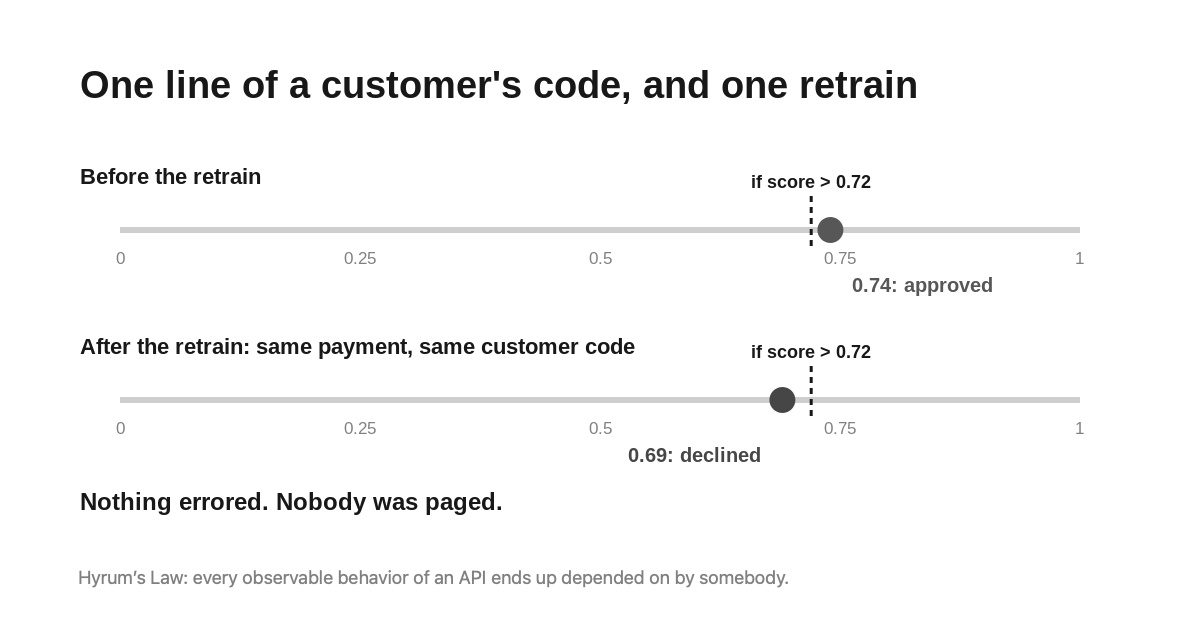
Take an internal service that returns a continuous venue-confidence or fraud-risk score between 0 and 1. An external developer integrates it, runs a week of shadow traffic, and writes if score > 0.72 directly into production application logic. Two months later your data science team retrains the model, calibration shifts downward by four points, and offline AUC improves across the board. Every HTTP response still returns valid JSON on time, yet your customer's approval rate drops overnight without a single 500 error.
Replacing the raw float with an enum like HIGH_CONFIDENCE does not dodge the contract question either. Somebody still owns the precision-recall trade behind that label and has to version behavior changes when underlying distributions drift.
Hyrum's Law observes that once an interface has enough users, consumers depend on every observable behavior regardless of what the documentation promised. Productizing an internal ML or data service forces explicit choices about score calibration stability, pinned model versions, shadow evaluation endpoints and deprecation windows.
I've seen that split across AWS IoT and Foursquare's Places and Unfolded products, where different developer segments often want opposite abstractions. Sophisticated enterprise teams ask for raw probabilities and component signals so they can tune thresholds against their own unit economics. Smaller app teams want an opinionated turnkey answer that works out of the box without hiring a scientist to calibrate cutoffs. Serving both cleanly takes deliberate API surface design, not a passthrough proxy.
Staffing the promise after launch
Before greenlighting an external developer product, be the surgeon rather than the architect: carve out the narrowest contract you can defend and trace how a customer notices, diagnoses and recovers when your output looks wrong for one critical record. Very often the sellable product requires tooling the internal consumer never needed: sandbox replay keys, deterministic test fixtures, versioned changelog diffs, per-tenant rate isolation and reason codes a support engineer can explain without reading model weights.
The organizational mistake to avoid is booking revenue upside while leaving ongoing platform operations unstaffed on the core team's night-and-weekend margin. Engineers hired to advance a ranking model or spatial pipeline suddenly inherit multi-year API version support, enterprise security questionnaires and customer onboarding escalations.
Choose that business deliberately and staff developer experience, documentation and version lifecycle as real roadmap work. External customers also surface product priorities that conflict directly with your own flagship app's roadmap, so leadership has to decide up front how shared compute quotas, breaking schema migrations and incident response priorities get arbitrated when internal and external deadlines collide.
An internal capability becomes a real platform on the day an outside builder can ship something durable on top of it without needing a personal favor from the engineers who wrote it.
Continue in Engineering Org & Leadership
The Next Engineer Has to Learn Somewhere
Last week I wrote why a token-consumption chart is an expense report rather than proof of engineering productivity. Funding open-ended exploration makes…
The File Was Third
The right file sat third on the candidate list. Then my bug-investigation agent ran one more search pass and pushed it down to fifteenth. I hit that…