Bring the Design
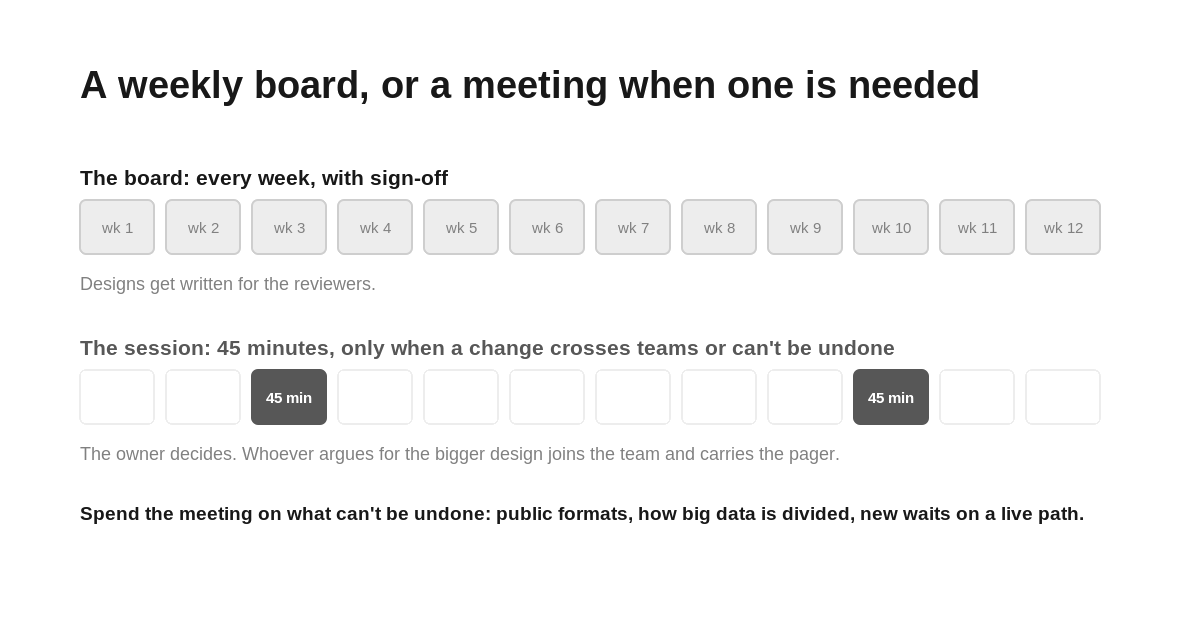
Engineers need a regular place to bring a design and work through it with Senior Staff and Principal peers while there is still room to change course. Explain what you're changing, show the constraints, and let experienced builders stress-test your assumptions early.
We have worked hard to build a 'show up' culture around that forum. An engineer should feel comfortable bringing an unfinished problem, naming the open questions honestly, and expecting a sharp, constructive conversation rather than a tribunal.
Nonblocking reviews and team ownership
Our architecture review is explicitly nonblocking. Teams do not sit idle waiting two weeks for a calendar slot, a traveling Principal engineer, or unanimous sign-off from a committee. The author and their owning team keep full accountability for both the technical call and production delivery. Their obligation is to weigh the feedback seriously and document what they decided to do with it.
Removing the veto gate changes how people show up. When a review board holds a rubber stamp, authors write defensive documents optimized to get out of the room cleanly. When the team keeps ownership, authors bring the thorny part of the design they are genuinely unsure about.
Writing for engineers outside your team
Preparing a crisp three-page design doc does half the architectural work before anyone speaks. Explaining an existing service clearly enough for an outsider to follow forces you to separate customer requirements from historical accidents in your codebase. Sprawling box-and-arrow diagrams hide fuzzy failure modes easily, whereas plain prose about state transitions, data contracts and rollback paths exposes gaps fast.
Presenting clearly under questioning is a learned craft. Engineers sharpen their judgment by deciding which constraints belong on page one, saying 'I haven't measured that yet' without defensiveness, and working through failure cases live at the whiteboard.
Listeners in the gallery gain just as much. Open design sessions let mid-level and senior engineers see how neighboring services behave, why an upstream API enforces an awkward rate limit, or what an upcoming storage migration will ask of client teams. Over six months, that shared mental model prevents dozens of parochial local optimizations before they start.
High-judgment feedback from Staff and Principal peers
Running a healthy review forum puts real expectations on Senior Staff and Principal engineers. Read the document beforehand. Grasp the team's delivery constraint before pitching your favorite abstraction. Because a Principal title carries organizational gravity, state explicitly whether a comment flags a concrete production risk or merely reflects personal taste, and take the schedule cost of any extra scope seriously.
When a team modifies a shared event schema, an experienced reviewer in the room often spots a downstream analytics or billing consumer that still depends on a field slated for deprecation. Catching that dependency saves an outage, and walking through how to audit schema consumers teaches the author a habit that carries into future migrations.
Capture the key risks raised and the team's final call in brief written notes so remote colleagues can follow the reasoning later. And focus calendar time where the blast radius warrants it: Amazon's 2015 letter to shareholders draws a lasting line between irreversible one-way doors and reversible two-way doors. Spend senior review bandwidth on public APIs, canonical data models and cross-team state boundaries, not routine internal refactors.
The single health metric I care about for architecture review is repeat attendance. When engineers voluntarily bring their next thorny design back to the room, the forum is doing its job.
Continue in Engineering Org & Leadership
The Next Engineer Has to Learn Somewhere
Last week I wrote why a token-consumption chart is an expense report rather than proof of engineering productivity. Funding open-ended exploration makes…
The File Was Third
The right file sat third on the candidate list. Then my bug-investigation agent ran one more search pass and pushed it down to fifteenth. I hit that…