Say the Number Before You Press Run
A kid builds a doorway sensor: an ultrasonic rangefinder wired to a Raspberry Pi and ten lines of Python that any tutorial or assistant will hand over. Send a ping, time the echo, turn it into a distance.
It works on the desk. In the hallway it reports people who aren't there.
So the kid asks the assistant in the other tab, and gets a new threshold. Paste, run, still ghosts. Ask again, and get a 'more accurate' formula. Paste, run, still ghosts. Twenty minutes later the sensor is just as haunted and nothing has been learned, because Python is the only layer on the screen and the fault isn't in the Python.
Taking the assistant away isn't the answer. Teach one habit alongside it instead.
Say the number before you press Run.
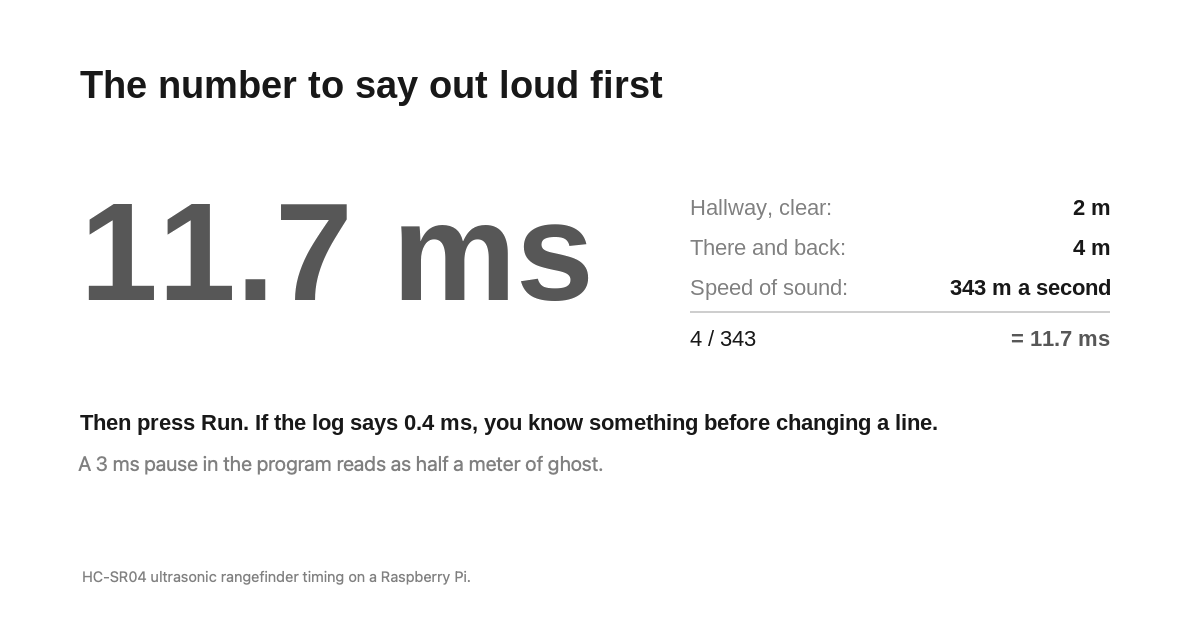
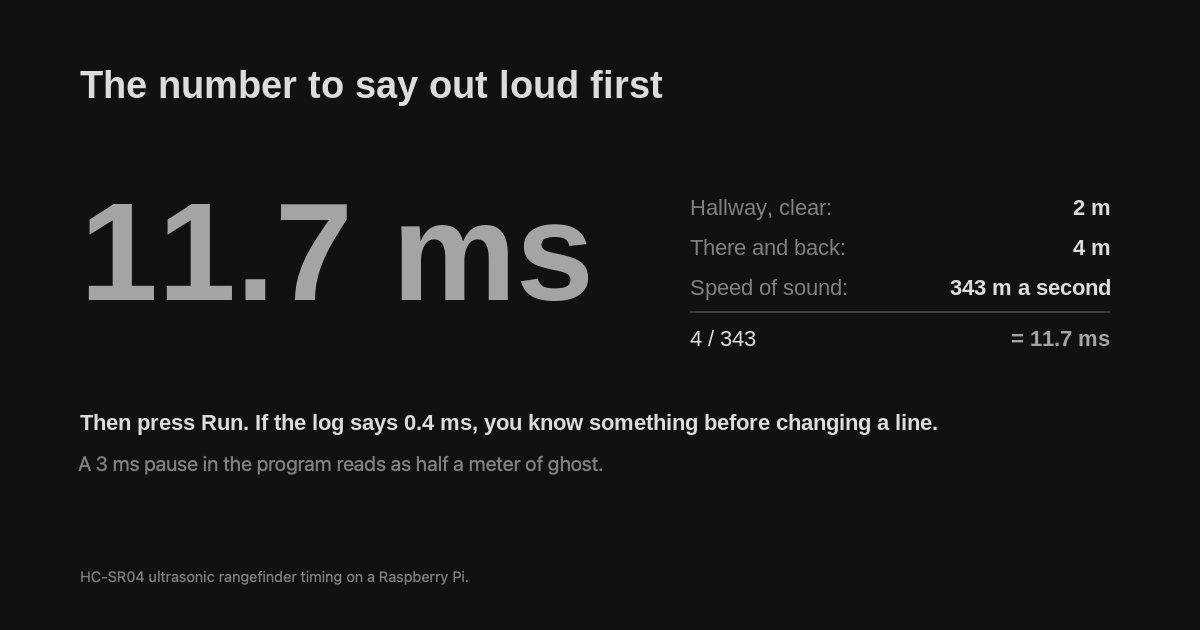
The far wall of the hallway sits two meters from the sensor. That makes a four-meter round trip for sound, which travels at roughly 343 meters per second, so the echo should return in about 11.7 milliseconds. Have them say that number out loud or write it on a sticky note first.
Then press Run. When the console prints 0.4 milliseconds, or nothing at all, they know something concrete before changing a single line of code. They hold an expectation and a measurement, and the bug lives in the gap between the two.
Print the raw echo time in milliseconds before converting it to distance. Once a reading passes through somebody else's formula, staring at 87 cm hides whether the sensor misread the room or the code botched the arithmetic.
Change one thing per run. When you're convinced you already see the fix, slowing down feels tedious. Hold the line anyway.
When two code edits on the screen fail, look off the screen. Linux scheduling jitter on a Raspberry Pi can stall a user-space Python loop for three milliseconds mid-ping, shifting the apparent wall by half a meter. Sound reflects off door frames and hardwood floors, and the HC-SR04 datasheet recommends waiting at least 60 milliseconds between measurement cycles so a late echo from ping one isn't read as ping two. Asking a chatbot for a fancier smoothing filter will never uncover any of that.
The habit transforms how kids use the assistant too. Typing 'it doesn't work' invites another blind rewrite. Typing 'I expected 11.7 ms and I'm seeing spikes at 14.7 ms' starts a real debugging conversation about OS timing and acoustic reflections. Make two numbers the entry ticket before asking the tab for help.
For a parent or mentor sitting in the next chair, that's the whole job: ask for the predicted number first.
For anyone building AI coding tools for students, the product tension cuts deeper. A tutor that asks 'what number did you expect?' before handing over code feels slower than one that autocompletes the answer immediately. Left alone, almost any kid picks the fast button, even though the slower question is where engineering judgment gets built.
Continue in Personal & Reflections
Leaving Cruise
After a little over two years leading Product, Engineering, AI, and Design at Cruise, I'm turning the page and joining Hims & Hers. I loved Cruise. It has…
What Stops When the Plan Changes
Announcing a new top priority is the easy half of changing a plan. Closing out the commitments people were already carrying is the real work. New priorities…