Read the Numbers Together
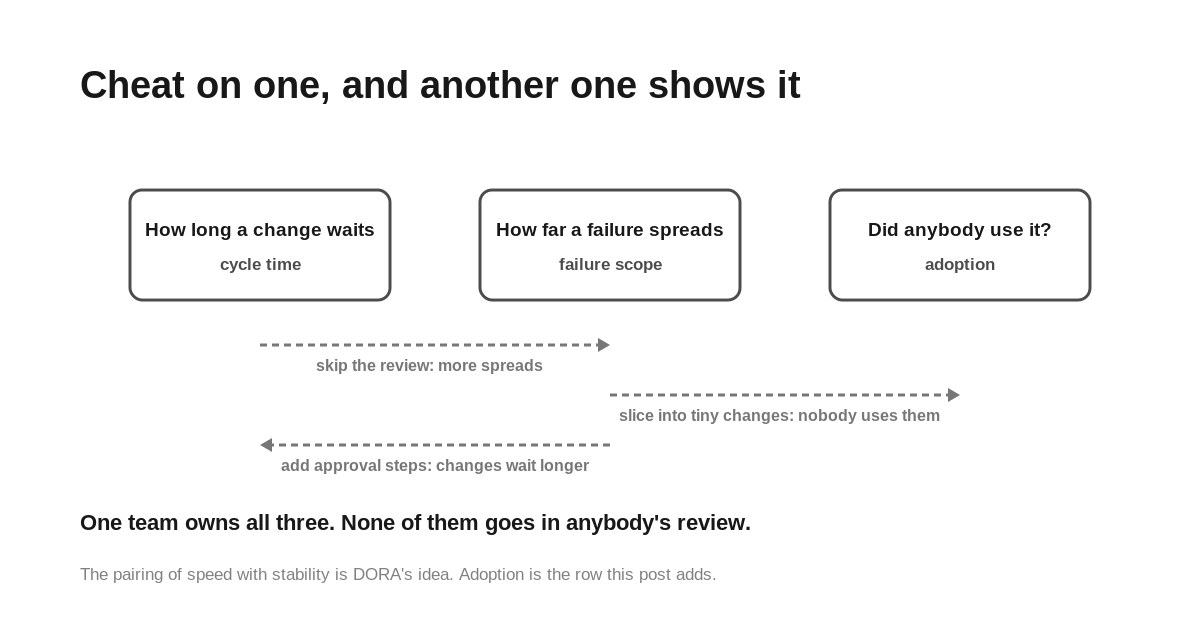
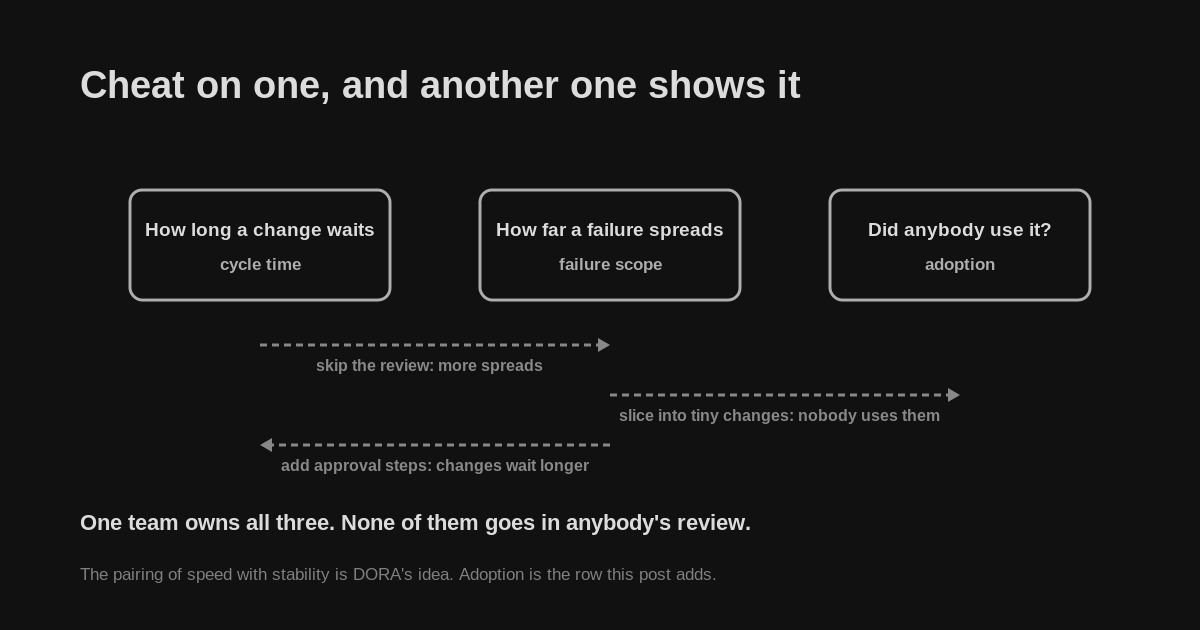
I don't give a green metric an easier conversation than a red one. Accepting every uptick at face value invites teams to bring prettier charts, and throws away the chance to learn why something genuinely improved.
Reviewing operational metrics across engineering orgs at Amazon and Foursquare, I learned that leaders rely on numbers because nobody can read every pull request, postmortem and customer ticket firsthand. Numbers tell you where to ask better questions. How an executive reacts in the first five minutes after a table goes on screen determines whether those numbers stay honest next quarter.
One scorecard, three numbers
Look at three measures read side by side for one product engineering group:
| Measure | Prior quarter | Current quarter |
|---|---|---|
| Median commit-to-production lead time | 2 days | 1 day |
| Share of active users touched by release regressions | 1% | 8% |
| Eligible users completing the target workflow | 12% | 12% |
Changes are reaching production twice as fast. Customer-visible release blast radius jumped eightfold. End-user workflow completion didn't budge.
Calling that quarter either a velocity win or a quality failure from the table alone misses the point. Maybe the team automated a slow staging bottleneck while a single unrelated config push caused the 8% incident spike. Or maybe engineers shaved a day off lead time by skipping canary bake windows on a feature customers still don't understand. Putting throughput, failure scope and product adoption inside one frame surfaces both hypotheses immediately.
Splitting those three numbers across separate operational, reliability and product reviews lets every owner tell a locally flattering story while the system as a whole stalls. Delivery speed, operational stability and customer impact belong on one page with shared leadership accountability.
Definitions, scope and individual ratings
Every engineering metric carries sharp edges that need to stay explicit rather than argued over from scratch each month. Starting the clock at git commit isolates CI, code review and deploy friction cleanly, while hiding six weeks of upstream spec churn before anyone wrote a line of code. Feature adoption jumps artificially whenever a flow becomes the default, and a critical storage migration moves customer workflow completion by zero percent even when it saves seven figures in infrastructure spend.
Pick clear definitions, write down what each metric intentionally excludes, and retire a metric openly once the bottleneck moves elsewhere.
Research frameworks help anchor that balance. DORA's Four Keys pair deployment frequency and lead time with change-failure rate and recovery speed. The SPACE framework demonstrates why single-number developer productivity proxies collapse under pressure. Neither framework replaces sitting down with the tech lead and understanding the concrete system in front of you.
Keep team delivery and reliability metrics strictly out of individual engineer performance formulas. Once PR count or cycle time enters individual ratings, rational engineers split trivial diffs, avoid thorny cross-team refactors and hesitate to raise uncomfortable architecture risks.
Good operational reviews also separate steady-state product delivery from foundational platform work. A database shard migration, security hardening sprint or SDK battery reduction needs a different leading indicator than a consumer checkout funnel, and forcing every team onto identical product-conversion columns just encourages creative relabeling.
A good metrics review ends with a specific operational adjustment: tightening progressive rollout gates, replicating a fast test harness across sibling repos, or admitting that a shipped feature solved the wrong user problem. And whenever the real blocker turns out to be an unmade staffing or priority call at the executive table, the leader running the review should walk out owning that action item.
Continue in Engineering Org & Leadership
The Next Engineer Has to Learn Somewhere
Last week I wrote why a token-consumption chart is an expense report rather than proof of engineering productivity. Funding open-ended exploration makes…
The File Was Third
The right file sat third on the candidate list. Then my bug-investigation agent ran one more search pass and pushed it down to fifteenth. I hit that…