Before You Show Me the Token Chart
I am glad to fund engineers exploring what AI tools can do, knowing upfront that plenty of those experiments will hit dead ends. Demanding a guaranteed ROI spreadsheet before a team has touched new tooling is a reliable way to keep budgets neat and engineering capability stagnant.
The conversation changes the moment somebody presents rising token consumption as proof that engineering throughput went up. Token volume is an invoice line, not an outcome metric.
Paying to learn
An engineer stress-testing an agent workflow often burns millions of tokens, takes longer than manual coding, and throws the branch away on Friday. That week still pays off if it produces a concrete finding the rest of the org can reuse: where context windows degrade on legacy repos, which test harness catches hallucinated imports, or where human sign-off remains non-negotiable.
Exploration budgets belong under explicit R&D framing: name the architectural question, cap the time and spend at risk, and write down what worked or failed so ten other teams do not buy the same lesson twice. Burning twice as many tokens never makes an experiment twice as instructive.
Paying to repeat
Workflows promoted into daily production delivery carry a stricter burden of proof. Claiming an agent speeds up shipping requires tracking changes well past pull-request creation.
Drafting time routinely drops while reviewer load spikes. Generated patches can pass unit tests yet introduce subtle coupling that doubles defect repair two sprints later, leaving on-call maintainers debugging code nobody in the group truly owns. Any honest investment review has to keep those downstream costs in the same frame as authoring speed.
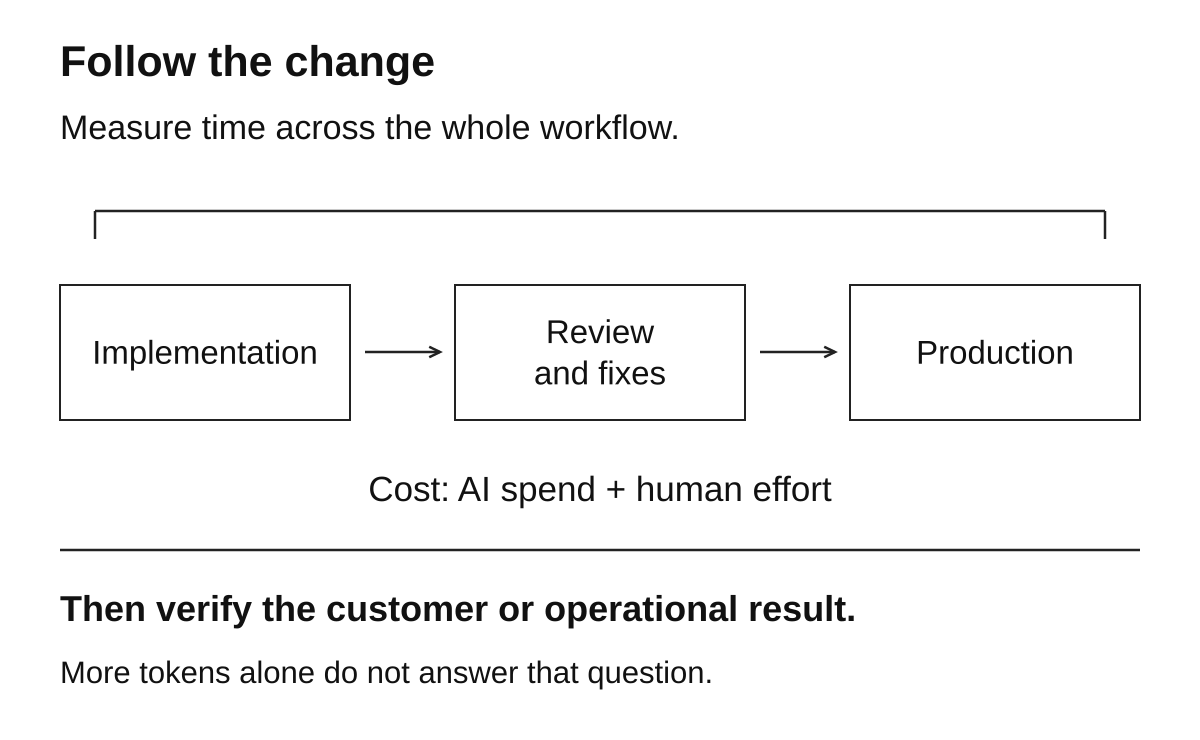
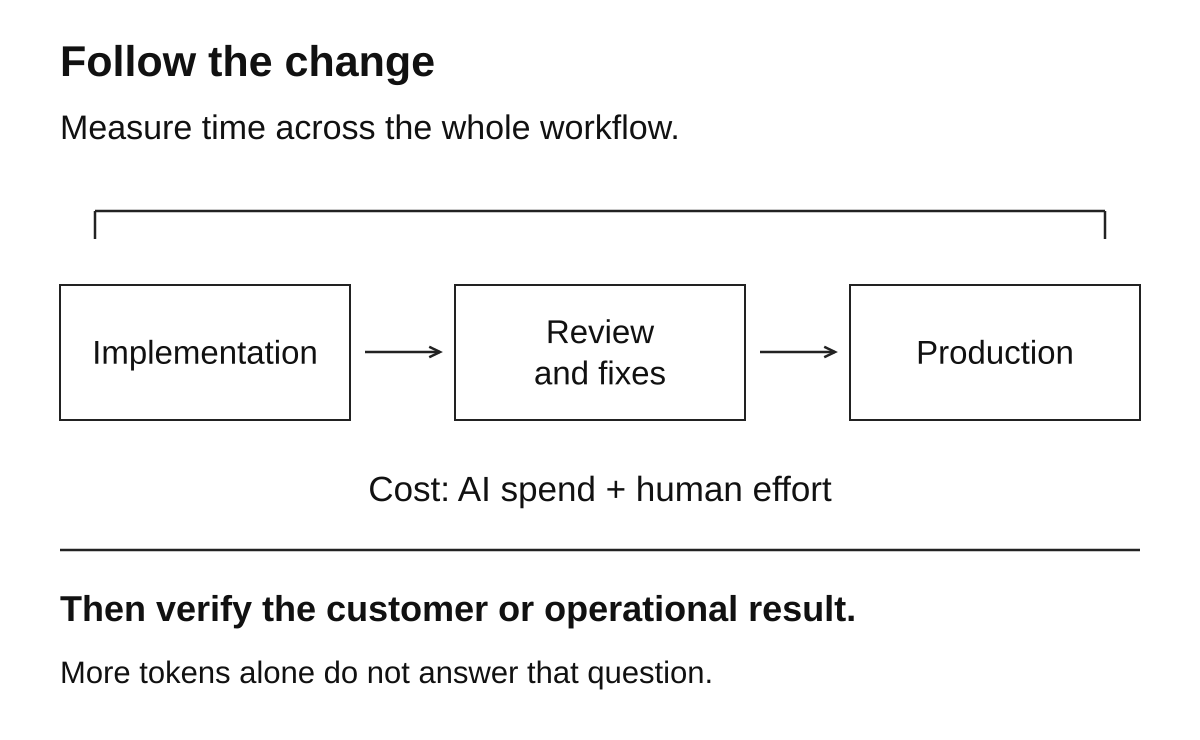
Evaluating a repeatable AI workflow means comparing end-to-end lead time, review rework, and escaped defect rates against how the team delivered comparable work before, holding scope and quality bars constant. That is the same multi-signal discipline I laid out in Read the Numbers Together: pairing delivery speed against regression scope and customer adoption keeps a single flattering chart from hiding downstream rework.
DORA's 2025 State of AI-assisted Software Development report frames AI as an amplifier of an engineering organization's existing delivery discipline rather than an automatic fix for weak foundations. Strong test suites and clean service boundaries convert fast drafts into shipped value, while brittle pipelines just accumulate larger review queues.
When end-to-end delivery genuinely improves, a higher monthly token bill is money well spent, and arbitrary token-cutting targets would be counterproductive. Conversely, cheap token spend that creates unowned maintenance debt is a bad trade at any price. Which downstream delivery signal has been most revealing as your teams expand agent usage?
Continue in AI Architecture & Agents
Save the Failing Run
Last Christmas I built a coding agent from scratch to read a spec, plan repository edits, run tests, and recover when checks failed. Single tool calls were…
I Won't Budget an AI Multiplier
I want engineers to use AI aggressively. I also have to decide what an engineering organization can promise on a roadmap. Those two commitments lead to very…