The Examples Are Part of the Specification
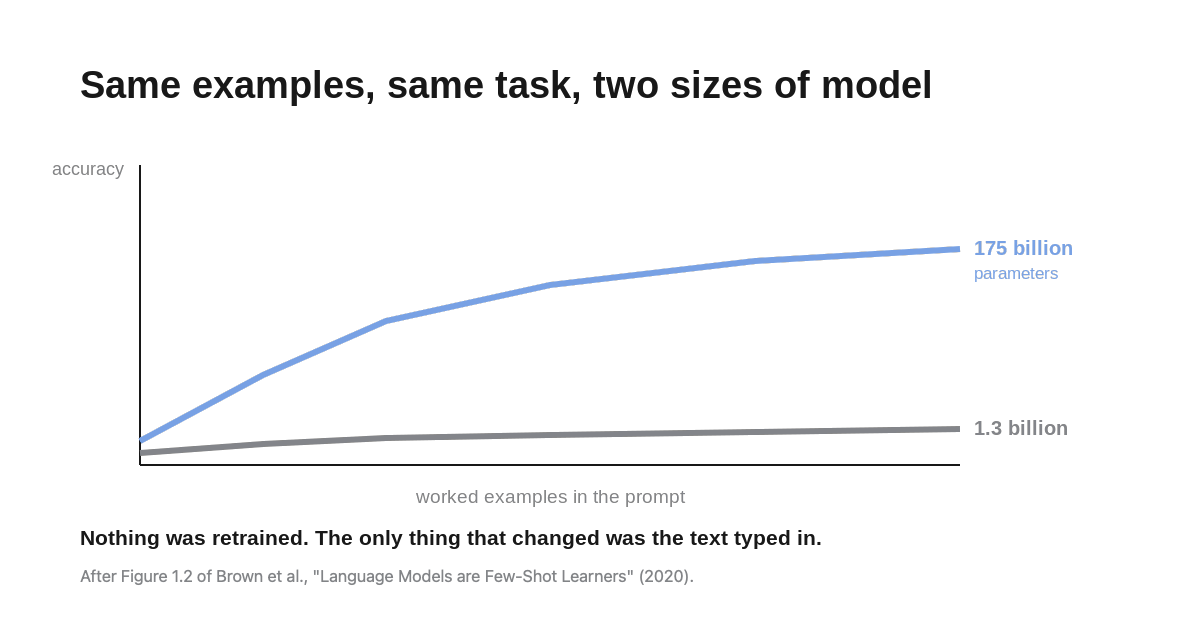
Putting worked examples in a prompt lets a team specify task behavior without changing a single model weight. That finding from Brown et al.'s 2020 GPT-3 paper gave application engineers a remarkably fast way to ship new language features, while quietly turning prompt examples into production specifications.
Look at a three-line ticket-routing prompt:
Assign one label: billing or access.

"I was charged twice." -> billing
"I can't sign in." -> access
"I want to cancel my account." ->
The first two lines make the classification look settled. The third exposes an unstated policy gap. Does account cancellation route to billing because recurring charges stop, or to access because credentials close? Or does the workflow require a retention queue that neither label covers?
No language model can guess which organizational rule the product team forgot to decide.
Appending one cancellation example settles that single phrasing while introducing silent side effects nearby. Route "I want to cancel my account" to billing, and requests to delete an inactive free profile may start landing in the billing queue too. Small demonstration sets look readable to their authors precisely because human readers fill in unwritten business context.
In the 2020 study, Brown and colleagues evaluate GPT-3 across dozens of benchmarks using natural-language instructions and a handful of demonstrations with zero gradient updates. Accuracy climbs sharply with parameter scale on many tasks while remaining brittle on others, including natural language inference and reading comprehension datasets. Few-shot prompting proves powerful as an interface without becoming a complete behavioral contract.
Follow-up work by Lu and colleagues on prompt ordering shows that permuting the exact same few-shot examples can swing classification accuracy from near state-of-the-art to near random chance. A set of demonstrations and a sequence of demonstrations behave as different programs.
Framing production design as a contest between prompting and fine-tuning misses that shared bottleneck. Fine-tuning only becomes worth its operational upkeep once traffic volume, input token latency, and stable label definitions justify maintaining training pipelines. Neither approach rescues an ambiguous taxonomy.
The third line in that routing prompt is a test for the product owner first. Before measuring whether a model learned the rule, the team responsible for the queue has to agree on where the rule draws the line.
Continue in Paper Reviews
A Tighter Bound, More Mistakes
In Lamb, Torr, and Rudner's November 2026 paper on LLM judges, what caught my attention is that the tightest statistical bound comes from an adapter making…
SGLang RadixAttention: Put the Prompt Timestamp Last
Giving a language model the current timestamp is reasonable. Putting that changing timestamp on line one of a long system prompt is expensive. That is the…