Chinchilla Is Optimal for Which Bill?
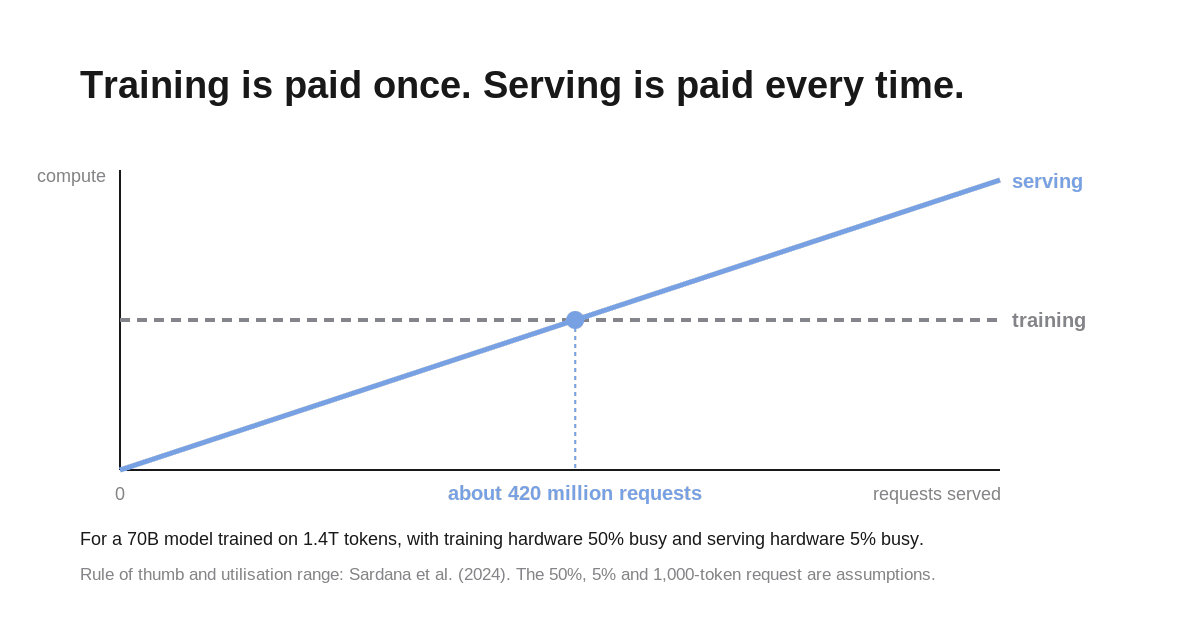
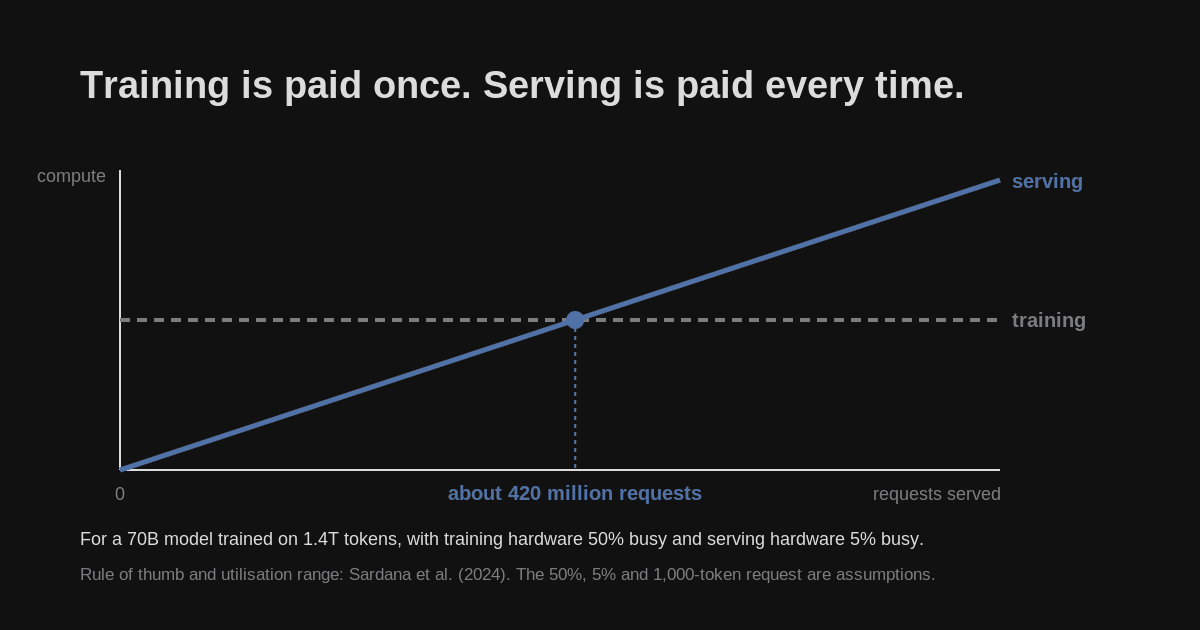
Calling a model compute-optimal means little to me until someone names the bill. Chinchilla optimizes a fixed training budget rather than lifetime serving spend.
Hoffmann and colleagues ask how to split a fixed pretraining FLOP budget between parameter count and training tokens. Their scaling laws shift spending toward smaller models trained on far more data than prior practice. At comparable training compute, the 70-billion-parameter Chinchilla model beat the 280-billion-parameter Gopher across downstream evaluations.
That finding settles how to spend a fixed training run. It says nothing about which model minimizes total cost once millions of production requests arrive.
Compare two model plans that hit the same product quality bar:
| Plan | One-time training cost | Serving cost per request |
|---|---|---|
| A | 100 units | 2 units |
| B | 160 units | 1 unit |
At 60 requests, both plans have spent 220 units. Below 60 requests, Plan A wins. Above 60 requests, Plan B pulls ahead on every call. Calling Plan A inefficient because Plan B wins at high volume makes no sense, and picking Plan A for a high-traffic service while ignoring inference cost makes just as little.
Sardana and Frankle put expected inference demand directly into the scaling equation. When lifetime token volume is high enough, spending extra compute upfront to overtrain a smaller model lowers combined training and serving cost. Their formulation also separates training hardware utilization from serving utilization, where memory bandwidth and batching constraints change effective FLOP pricing.
The quality constraint in that comparison carries as much weight as the arithmetic. Overtraining a smaller architecture stops saving money the moment it misses a capability threshold the larger model clears. Product lifespan shifts the math too: a model replaced in six weeks amortizes upfront training across far fewer requests than a workhorse model serving traffic for eighteen months. Latency budgets and GPU memory limits often eliminate the larger candidate before total cost even enters the spreadsheet.
In an architecture review, naming the objective up front avoids talking past each other. Minimizing pretraining loss for a fixed cluster allocation and minimizing total cost of ownership at target latency are two distinct optimizations, and they routinely point to different model sizes.
Sources: Hoffmann et al., Training Compute-Optimal Large Language Models (2022) and Sardana and Frankle, Beyond Chinchilla-Optimal (December 2023).
Continue in Paper Reviews
A Tighter Bound, More Mistakes
In Lamb, Torr, and Rudner's November 2026 paper on LLM judges, what caught my attention is that the tightest statistical bound comes from an adapter making…
SGLang RadixAttention: Put the Prompt Timestamp Last
Giving a language model the current timestamp is reasonable. Putting that changing timestamp on line one of a long system prompt is expensive. That is the…