45 Seconds
Swapping a rider's car after they have started walking to the corner can improve fleet utilization while breaking the product promise.
Once a ride app displays a confirmed vehicle and license plate at a specific pickup spot, the assignment stops being an internal dispatch variable. If the matcher finds another vehicle that can arrive 45 seconds sooner and swaps the trip mid-walk, average pickup latency drops on the metrics dashboard while the rider stands at the curb looking for a car that is no longer coming.
Before confirmation, vehicle assignment belongs to the optimizer. After confirmation, a person organizes physical movement around what the screen just told them. They leave a lobby or cross a busy intersection to meet the car. Changing the assignment changes the service without violating a single backend availability target.
Freezing every match the instant a request arrives carries its own penalty. Locking a car too early can strand another rider across town with a much longer wait. The rider hurt by a late swap is immediately frustrated, while the rider who lost out on a faster match never sees the counterfactual. Marketplace product work has to weigh both sides honestly.
Leading engineering, product, and design in one organization puts that tension on a single desk. Consolidation removes organizational handoffs, yet it never supplies the right answer automatically. You become responsible for fleet math and street-corner confusion at the same time.
Coming up through engineering creates a predictable blind spot here. Engineers gravitate toward clean, continuous metrics like mean wait time or fleet utilization because you can chart a 45-second gain every afternoon. A rider's confidence that the plate on their phone will stay their plate is harder to instrument, so purely quantitative reviews tend to underprice it.
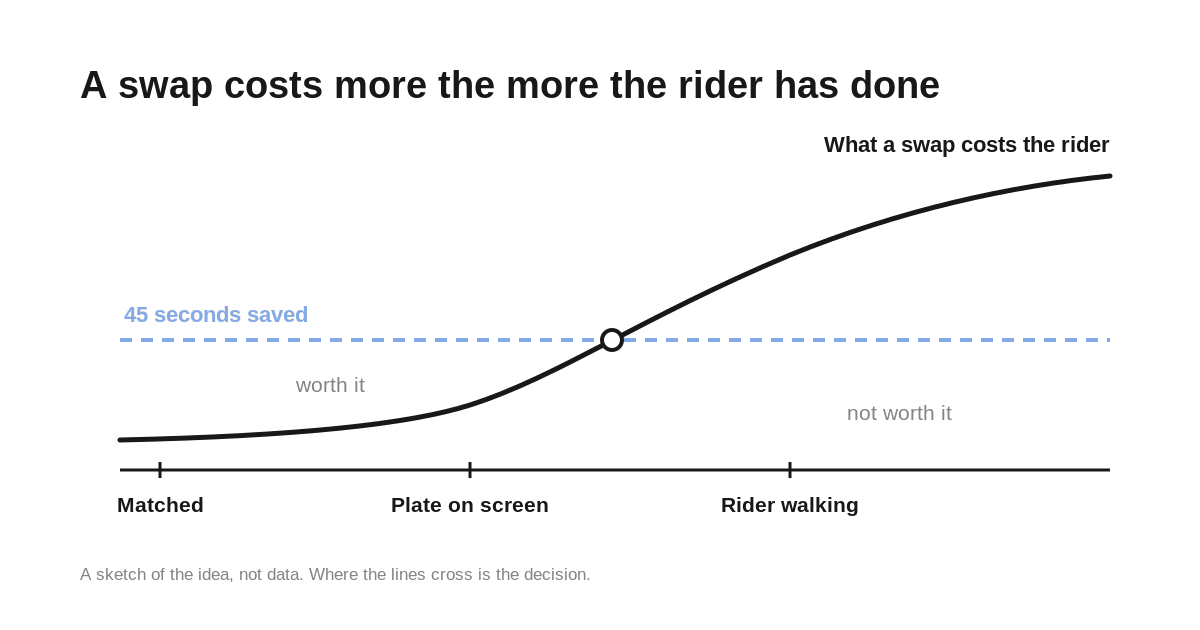
In dispatch design, the penalty for swapping a vehicle has to climb as rider commitment deepens: low while matching in the background, steeper once the plate renders on screen, and prohibitive once the rider starts walking toward the pickup zone. Testing where those thresholds sit requires pairing operational telemetry with field observation and design critique.
Leading product and design alongside engineering taught me that putting them under one roof only works if strong product and design leaders have the room to challenge an optimization that looks great in simulation. When you own the whole system, you answer for the seconds saved across the fleet and for the person standing on the corner wondering where their ride went.
Continue in Personal & Reflections
Leaving Cruise
After a little over two years leading Product, Engineering, AI, and Design at Cruise, I'm turning the page and joining Hims & Hers. I loved Cruise. It has…
What Stops When the Plan Changes
Announcing a new top priority is the easy half of changing a plan. Closing out the commitments people were already carrying is the real work. New priorities…